

End-of-Day vs. Intraday Trailing Drawdown Explained
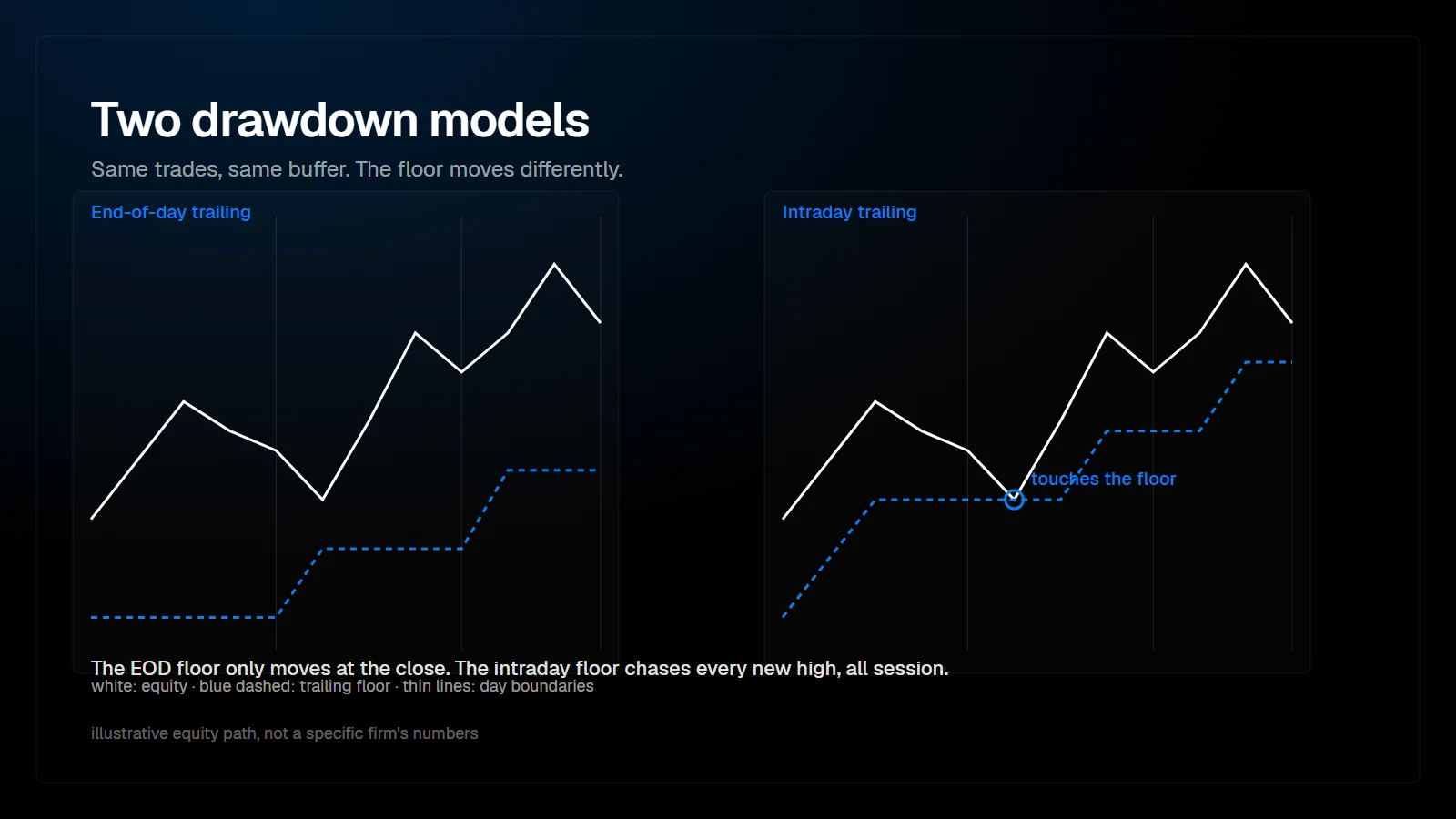
A trailing drawdown is a loss floor that rises as an account's balance grows, and stays there if the balance falls back. The difference between the two common versions is when the floor updates: an end-of-day trailing drawdown moves only at the close of each trading day, while an intraday trailing drawdown moves the moment a new high is reached, even mid-session. The intraday version is the stricter one, because it never gives back room that a session's own swing already used.
What does trailing mean in a drawdown limit?
The floor follows the balance up, and locks in place when the balance pulls back.
A static drawdown never moves; the floor is fixed to the starting balance for the life of the account. A trailing drawdown starts the same way but rises as the account earns profit, protecting some of the gains from ever going back below a threshold. What separates the two trailing variants is the trigger for that rise.
How does end-of-day trailing drawdown work?
The floor is recalculated once, from the closing balance, and holds flat through the next session.
Topstep's Maximum Loss Limit (MLL) is the clearest documented example: it trails the end-of-day closing balance, not the intraday high. In Topstep's own worked example, a $25,000 account with a $1,000 MLL that gains $1,000 intraday (balance hits $26,000) and gives half back to close at $25,500 sees its limit move to $24,500, based on the close, not the $26,000 peak. The limit is monitored in real time during the session, but it only steps up once, at the close, and locks permanently once it reaches the account's starting balance.
How does intraday trailing drawdown work?
The floor rises the instant a new equity high prints, during the session, not just at the close.
Under an intraday trailing model, the account's running high water mark, whether that intraday peak was ever realized as a closed profit or not, sets the floor continuously. A trade that runs up nicely and then gives back most of its gain before you close it can push the floor uncomfortably close to the current balance, purely because of a high the balance touched and left. Apex Trader Funding names this distinction directly in its own account structure, offering separate EOD Trailing Drawdown Accounts and Intraday Trailing Drawdown Accounts as different products with different mechanics.
| End-of-day trailing | Intraday trailing | |
|---|---|---|
| Floor updates on | The closing balance, once per day | Any new equity high, continuously |
| Intraday give-back | Does not move the floor | Can move the floor up before you exit |
| Typical feel | More room within a session | Tighter, punishes holding through a full round trip |
| Documented example | Topstep Maximum Loss Limit | Apex Trader Funding Intraday Trailing Drawdown Accounts |
The core difference. Exact figures, buffers and lock conditions vary by firm; confirm the current version before trading.
Why does the difference matter for how you trade?
It changes how much room a position has after it has already worked in your favor.
Picture a trade that runs up nicely intraday and then rotates back toward entry before you manage it. Under an end-of-day model, that swing does not touch the drawdown floor at all as long as the session still closes above it. Under an intraday model, the floor already rose to track that peak, so the same rotation can land the account much closer to its limit, or through it, well before the day is over. Neither model is automatically safer; the intraday version simply demands tighter management of profit that has not been locked in yet.
Does the trailing floor rise forever?
Usually not. Most trailing drawdown limits stop trailing once they reach the account's starting balance.
Topstep states this directly for the Maximum Loss Limit: once it reaches the account's starting balance, it locks there permanently and stops trailing further gains. From that point, the account is effectively protected against ever going net negative from its starting capital, while everything above it is exposed to ordinary drawdown risk again. Confirm whether a lock point applies before assuming a firm's trailing limit behaves the same way; it is a detail that differs by firm and is easy to miss in a quick skim of the rules.
How do you check which model a firm uses?
- Read the specific account's rules page, not a general overview. Some firms, including Apex, sell both drawdown types as separate account products.
- Look for whether the rulebook mentions the closing balance specifically, or an intraday or unrealized high. The wording usually gives it away even without the words “end-of-day” or “intraday.”
- Check whether the limit is stated to lock once it reaches the starting balance, since that changes the account's long-run risk once it is well in profit.
- Re-check after a rule change. Apex 4.0, effective for accounts opened from March 1, 2026, changed several other evaluation rules at the same time as the account structure; a firm that touches drawdown once can touch it again.
The PFT Terminal's prop firm tracker follows the drawdown buffer per account alongside the profit target and the consistency rule, so the distance to the floor is visible while a trade is still open rather than reconstructed afterward.
FAQ
Which is more forgiving, end-of-day or intraday trailing drawdown?
End-of-day trailing is generally more forgiving within a session, because a peak that fades before the close never raises the floor. Intraday trailing raises the floor the moment the peak happens, whether or not the balance holds there.
Is a trailing drawdown the same as a daily loss limit?
No. A daily loss limit caps how much an account can lose in one session and typically resets each day. A trailing drawdown tracks the account's overall high water mark and does not reset; the two rules usually apply together, not instead of each other.
Does unrealized profit count toward the trailing floor?
Under an intraday trailing model, yes, typically: an open position's floating gain can raise the floor before it is closed. Under an end-of-day model, only the closing balance counts, so an intraday unrealized peak that fades before the close does not raise anything.
Can the drawdown type change after I have an account?
Firms have changed account structures between rule-set versions before, generally affecting new accounts going forward rather than converting an existing one. Read the announcement for any rule change rather than assuming your account is grandfathered or migrated.
This article is educational content, not financial advice.