

The Prop Firm Consistency Rule Explained
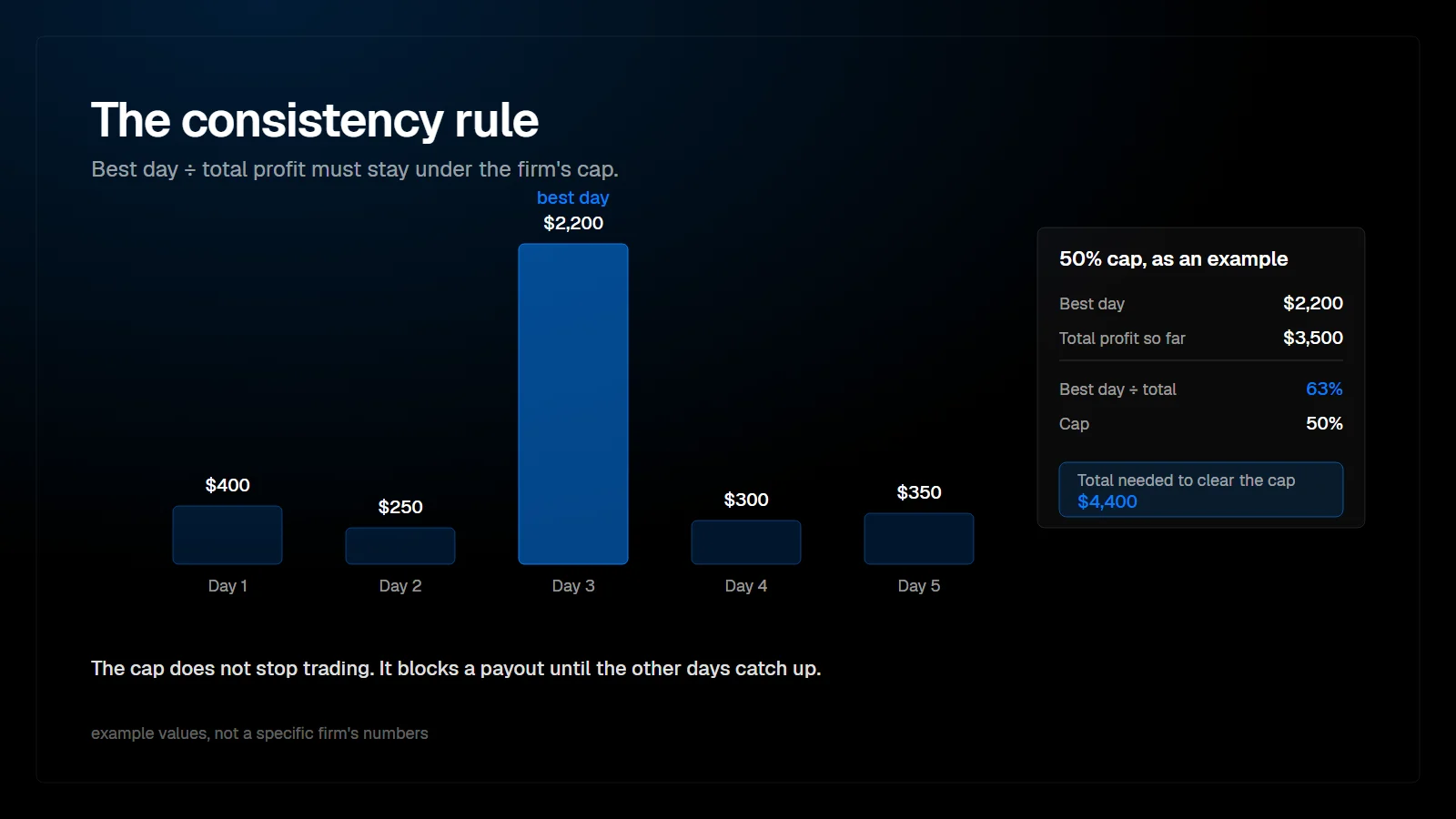
The consistency rule at a futures prop firm caps how much of your total profit a single trading day is allowed to represent. If a firm sets the cap at 50%, your best day has to stay under half of your overall profit before a payout is approved. It does not stop you from trading. It stops a payout from going through until your other days catch up to your best one.
What does the consistency rule actually limit?
One lucky day buying the payout.
Without a cap, a trader could pass an evaluation or clear a funded target with a single oversized winning trade and call it repeatable performance. The consistency rule forces the profit to be spread across more than one session before the firm pays it out. It is a payout gate, not a drawdown rule and not a way to block a big win itself; the profit stays in the account either way.
How is the consistency rule calculated?
Divide your best day's profit by your total profit. If the result is above the firm's cap, you are not clear yet.
| Day | Profit |
|---|---|
| Day 1 | $400 |
| Day 2 | $250 |
| Day 3 (best day) | $2,200 |
| Day 4 | $300 |
| Day 5 | $350 |
| Total profit | $3,500 |
Worked example at a 50% cap. Numbers are illustrative, not a specific firm's figures.
Best day divided by total is $2,200 / $3,500, or about 63%, which is above a 50% cap. To clear it, total profit needs to reach at least $2,200 / 0.5 = $4,400, meaning another $900 spread across other days, none of which can itself become the new outsized day.
What percentage do prop firms actually use?
It varies by firm, by account stage, and it changes during the year. Two examples, checked directly against each firm's own help center in September 2026.
| Firm | Stage | Cap | Source |
|---|---|---|---|
| Topstep | Trading Combine | 55% of the profit target | help.topstep.com, “Consistency at Topstep” |
| Topstep | Express Funded Account, consistency payout path | 40% of total net profit | help.topstep.com, “Consistency at Topstep” |
| Apex Trader Funding | PA / funded account, current rule set | 50% of total profit at payout | apextraderfunding.com help center, “50% Consistency Requirement” |
As of September 2026. Firms revise these figures during the year; check the current rulebook before trading.
Apex's current 50% figure replaced an older Legacy rule of 30%, which still applies to accounts opened before the firm's rule change on March 1, 2026 (Apex 4.0). Two traders quoting different percentages for the same firm are often just on different account generations, not making a mistake. Topstep also runs two paths on its Express Funded Account: a standard path with no consistency requirement but five separate winning days, and a consistency path with only three winning days needed but the 40% cap applied.
Does the consistency rule apply during the evaluation, once funded, or both?
It depends on the firm and the stage, and it is one of the details worth checking before signing up rather than after.
At Topstep the 55% figure applies only to the Trading Combine, the evaluation stage; once funded, only the Express Funded Account's own payout paths (5 days standard, or 3 days plus 40% consistency) apply. At Apex the 50% rule applies at the point of a payout request on a funded account, calculated on profit earned since the last approved payout, or since the account started if there has not been one yet. Neither firm's number transfers to the other's stages.
What happens if you fail the consistency check?
The account stays open. The payout request does not go through.
- The account is not breached and trading continues normally.
- A payout request is unavailable, or an evaluation's profit target effectively rises, until the ratio clears the cap.
- The fix is more qualifying days, not a smaller position on the next trade. A single new big day can make the ratio worse if it is not proportionally larger than what came before.
- Some firms recalculate from account inception, others from the last approved payout. That window changes how quickly an old oversized day stops counting against you.
How do you plan around the consistency rule?
Treat it as a reason to keep position size steady across days rather than swinging for a single large one, since a single day that carries most of the account's profit is exactly the pattern the rule is built to catch. Journaling the daily P&L against the running total makes the ratio visible before a payout request rather than after it is rejected.
The PFT Terminal's prop firm tracker follows the drawdown buffer, the profit target and the consistency rule per account as trades come in, so the ratio in the table above is not something you have to calculate by hand mid-session.
FAQ
Does the consistency rule apply to losing days?
No. It measures your best profitable day against total profit. Losing days do not enter the ratio, though they lower total profit, which can make an old winning day count for a larger share of it.
Can a firm have no consistency rule at all?
Some funded-account programs advertise accounts without one, usually alongside a different constraint elsewhere in the rulebook, such as a stricter daily loss limit. Check the specific account's current terms rather than assuming based on the firm's other products.
Does the consistency rule change my max drawdown?
No, they are separate mechanics. The consistency rule gates a payout; the drawdown limit can end the account. See the article on end-of-day versus intraday trailing drawdown for how that one works.
Is a 30% or 50% cap better for a trader?
Neither is better in general. A lower cap forces profit across more days before a payout, a higher cap allows a bigger single day to still qualify. Both reward the same underlying behavior: repeatable results over one lucky session.
This article is educational content, not financial advice.