

Topstep vs. Apex Trader Funding: Rules Compared
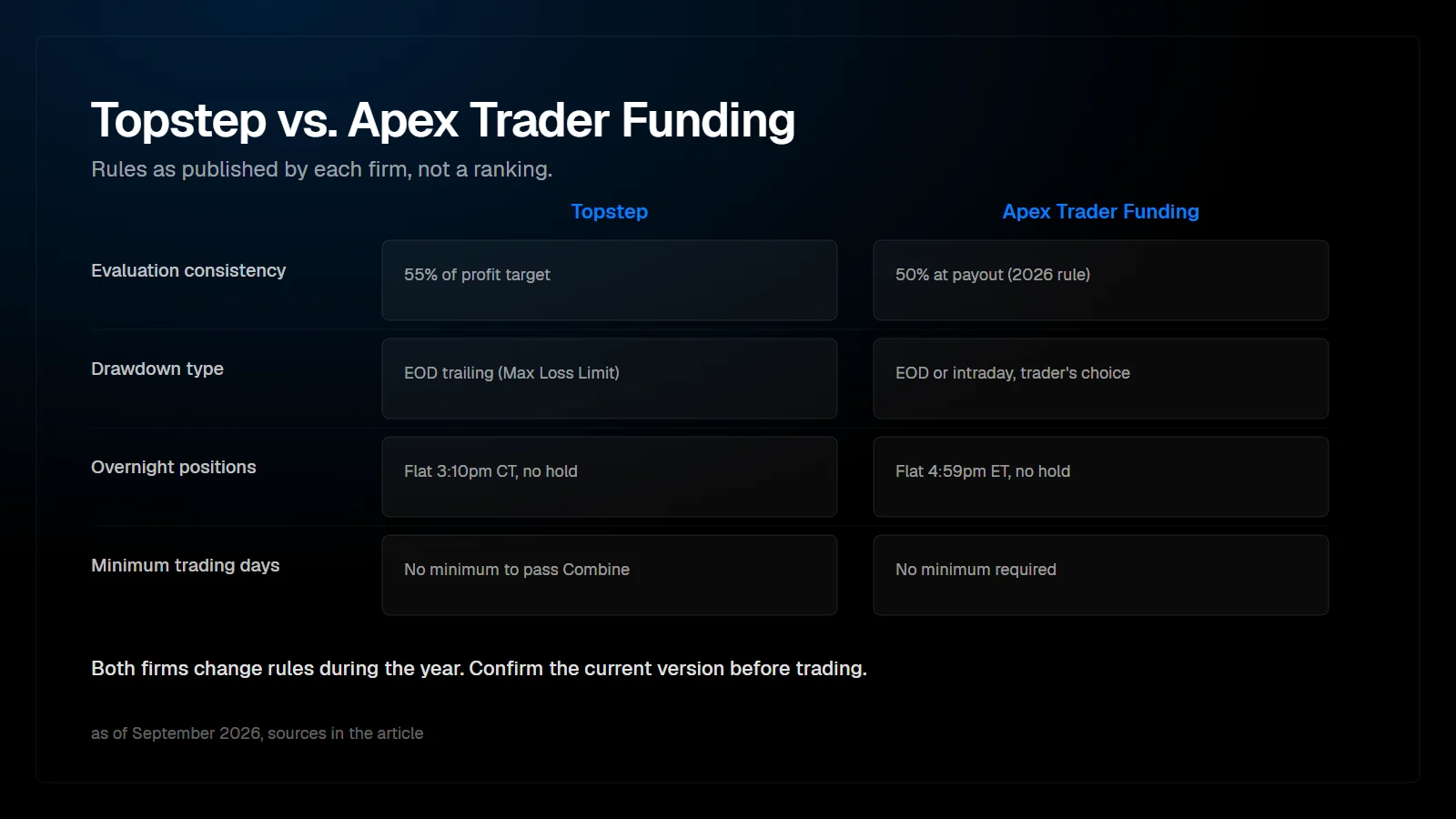
Topstep and Apex Trader Funding are both futures prop firms, but they run different mechanics end to end: Topstep uses a single end-of-day trailing drawdown and a consistency rule that shifts between its evaluation and funded stages, while Apex lets a trader pick between an end-of-day or an intraday trailing drawdown account and applies one consistency percentage at payout. Neither structure is objectively better; they suit different ways of managing an open position.
What is the evaluation model at each firm?
Topstep's evaluation stage is called the Trading Combine, and passing it moves a trader to an Express Funded Account. Apex's evaluation is a Performance Account (PA) evaluation, and a passed evaluation moves to a Performance Account. The naming differs, but the shape, an evaluation stage before a funded stage, is the same at both firms.
How does the consistency rule differ?
Both firms cap how much of total profit a single day can represent, but at different points and different percentages.
| Topstep | Apex Trader Funding | |
|---|---|---|
| Evaluation stage | 55% of the profit target (Trading Combine) | Not separately documented as a distinct evaluation figure |
| Funded stage | 40% of total net profit, on the Express Funded Account's consistency payout path only | 50% of total profit, checked at each payout request |
| Alternative path | A standard payout path exists with five winning days and no consistency check | No published alternative path |
As of September 2026, from each firm's own help center. Both firms revise these figures during the year.
Apex's current 50% figure applies to accounts under its current rule set (Apex 4.0, for accounts opened from March 1, 2026 onward); older Legacy accounts ran a 30% rule instead. See the article on the prop firm consistency rule for how the calculation itself works.
How does the drawdown mechanic differ?
Topstep runs one model for every account: the Maximum Loss Limit trails the end-of-day closing balance and locks permanently once it reaches the starting balance. Apex sells two separate account types, EOD Trailing Drawdown Accounts and Intraday Trailing Drawdown Accounts, so the choice of mechanic sits with the trader at signup rather than being fixed by the firm. See the article on end-of-day versus intraday trailing drawdown for what that choice actually changes mid-session.
What are the overnight and trading-hours rules?
Both firms require a flat book before a fixed daily cutoff, at different clock times because of their reference time zones.
| Topstep | Apex Trader Funding | |
|---|---|---|
| Flat by | 3:10pm CT | 4:59pm ET |
| Trading resumes | 5:00pm CT | 6:00pm ET |
| Overnight holding | Not permitted | Not permitted |
How do minimum trading days and payouts differ?
Topstep's Trading Combine has no fixed minimum number of days; a trader can pass in as few as two, and the 55% consistency cap does the work of preventing a one-day pass. On the funded stage, the standard payout path needs five separate winning days, or three winning days on the 40%-consistency path. Payout splits at Topstep moved to 90/10 from the first dollar for accounts opened from January 12, 2026, with accounts from before that date keeping 100% of the first $10,000 in lifetime profit before the 90/10 split applies.
Apex publishes no minimum trading-day requirement on its evaluation. Payout terms, splits and caps have changed more than once at Apex during 2026 alongside the broader Apex 4.0 rule update, so a specific split figure is left out here deliberately; check the current payout policy on apextraderfunding.com, or in our own prop firm comparison, before relying on a number from any article, including this one.
Which fits which trader?
The honest answer is that the rulebook fits the trading style, not the other way round. A trader who tends to let a winning position round-trip before managing it sits more comfortably under an end-of-day trailing model, since a mid-session peak that fades does not tighten the floor. A trader who manages positions actively and closes profit as it happens loses less to the stricter version of an intraday trailing account. The consistency rule matters most to a trader whose results lean on a small number of outsized days rather than a broad base of smaller wins, regardless of which firm holds the account.
Rules at both firms change during the year, so a comparison like this one is a starting point for reading the current rulebook, not a replacement for it. The PFT Terminal's prop firm tracker follows the drawdown buffer, profit target and consistency rule for whichever firm and account size you actually trade.
FAQ
Is Topstep or Apex Trader Funding cheaper?
Pricing changes often at both firms and is not reproduced here for that reason. Check current evaluation and account fees directly on each firm's pricing page, or in our prop firm comparison, before comparing cost.
Can I hold both a Topstep and an Apex account at the same time?
Nothing at either firm ties an account to exclusivity with another prop firm as a rule discussed in this article; most futures traders who use multiple firms do so to diversify account rules and payout schedules, not because one firm requires it.
Does Apex's intraday trailing account have a higher profit target?
Account parameters, including profit targets, are set per account size and are not the same thing as the drawdown mechanic. Check the specific account size's parameters on apextraderfunding.com rather than assuming the drawdown type changes the target.
Which firm has the stricter consistency rule?
Numerically, Apex's current 50% figure and Topstep's Express Funded consistency path at 40% are close, with Topstep's 40% being the tighter cap of the two funded-stage figures. Topstep's Combine figure of 55% only applies during evaluation, so the two are not directly comparable stage for stage.
This article is educational content, not financial advice.