

Gamma Levels Explained: What GEX Means for ES and NQ
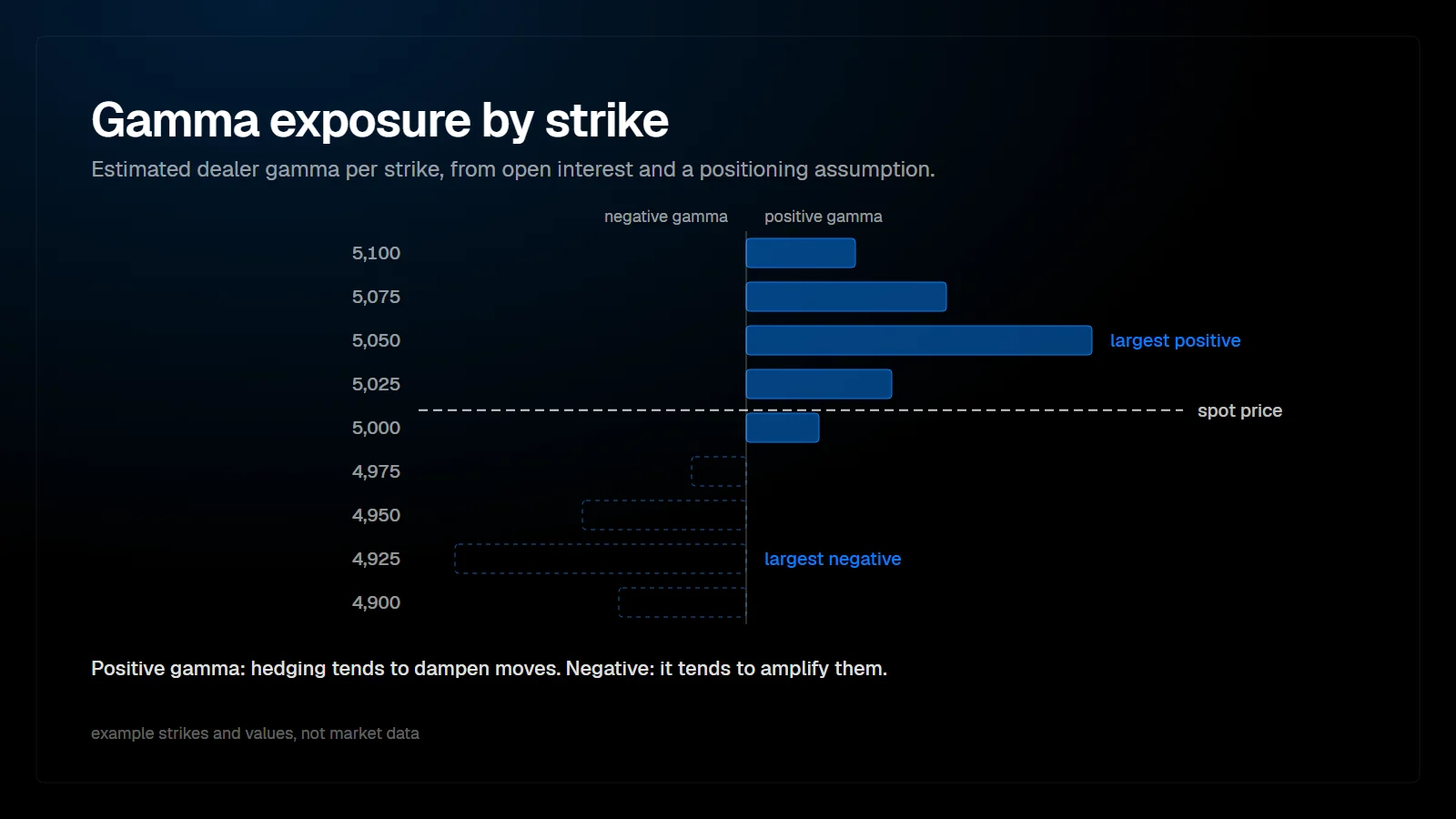
Gamma exposure, or GEX, estimates how much options dealers need to buy or sell in the underlying as price moves, based on open options positions. Gamma levels are the strikes where that hedging pressure concentrates. For ES and NQ traders, they come from options on the S&P 500 and the Nasdaq-100 and are mapped onto the futures chart.
What is gamma in options?
The rate at which an option's delta changes as the underlying moves.
Delta measures how much an option's price changes for a one-point move in the underlying. Gamma measures how fast that delta itself changes. Gamma is highest for options near the money and close to expiration, and falls off for options far from the current price.
For a market maker who hedges the delta of an options position in the underlying, gamma is what forces the hedge to be adjusted as price moves. That adjustment is real buying and selling, and when positions are large it can become visible in the tape.
How is gamma exposure (GEX) calculated?
GEX sums the gamma of all open options at each strike, weighted by open interest and contract size, with an assumption about which side dealers hold.
A common formulation per strike is gamma times open interest times the contract multiplier times the underlying price squared times 0.01. The result is read as the dollar amount of the underlying that dealers would need to trade for a one percent move. Providers scale this differently, so absolute GEX numbers from two sources are rarely comparable. The shape across strikes matters more than the headline figure.
The critical step is the sign. Exchanges publish open interest, but not who is long or short. The simplest model assumes dealers are long the calls customers sell and short the puts customers buy. That is a simplification. More elaborate models use trade-level data to estimate positioning. Every GEX figure rests on such an assumption, and it can be wrong.
What is the difference between positive and negative gamma?
In positive gamma, dealer hedging tends to dampen moves. In negative gamma, it tends to amplify them.
| Regime | Dealer hedge when price rises | Dealer hedge when price falls | Typical tape character |
|---|---|---|---|
| Positive gamma | Sell the underlying | Buy the underlying | Tendency toward mean reversion and narrower ranges |
| Negative gamma | Buy the underlying | Sell the underlying | Tendency toward trending moves and wider ranges |
Mechanism under the standard dealer-positioning assumption. The last column describes a tendency, not a guarantee.
The logic: a dealer who is long gamma gets longer delta as price rises and must sell to stay hedged, and gets shorter delta as price falls and must buy. That flow leans against the move. A dealer who is short gamma faces the opposite and must trade with the move.
How do gamma levels map to ES and NQ?
The options that dominate gamma for these markets are largely on the cash indexes and ETFs: SPX and SPY for the S&P 500, NDX and QQQ for the Nasdaq-100, alongside options on the futures themselves.
Futures trade at a basis to the cash index, which reflects interest rates and expected dividends until expiration. A gamma level computed at an SPX strike has to be shifted by the current basis to land at the corresponding ES price. ETF strikes additionally need converting by the ratio between the ETF and the index, which drifts over time. Tools that skip this conversion plot levels in the wrong place.
| Step | Value |
|---|---|
| SPX strike | 5,000 |
| Current ES minus SPX basis (example) | +30 points |
| Level on the ES chart | 5,030 |
Example conversion with illustrative numbers, not market data.
What are the limits of GEX?
- Open interest updates once a day. Intraday positioning, especially in same-day expiring options, is not reflected until the next update.
- The sign assumption can be wrong. If customers are net long calls at a strike, the real dealer exposure is the reverse of the model.
- Expiration changes the picture. Large amounts of gamma expire at monthly and quarterly expirations, and levels can shift materially afterwards.
- Hedging is only one flow. Macro news, rebalancing and discretionary traders can overwhelm it.
For these reasons, gamma levels are best read as a map of where hedging pressure may concentrate, then checked against order flow when price gets there. A level where dealers are expected to buy, and where the footprint shows heavy selling being absorbed, is a stronger read than the level alone.
How does PFT approach gamma levels?
PFT Forge is an options module in development that turns dealer positioning, gamma levels and options flow into levels for ES and NQ, on the web and inside the chart. It is not released, and there is no price or date yet. Until then, the articles in this category explain the mechanics, so that any GEX level from any source can be judged on its assumptions.
FAQ
What does GEX stand for?
Gamma exposure. It estimates the aggregate gamma held by options dealers across strikes, expressed as how much of the underlying they would trade to stay hedged.
Is high positive GEX bullish?
Not directly. Positive gamma describes how the market may move, not in which direction. It points to dampened moves, which can occur either way.
Why do different GEX providers show different levels?
They use different data, different sign assumptions, different handling of expirations and different scaling. Compare the logic behind the levels, not only the numbers.
Do gamma levels work for NQ as well as ES?
The mechanism is the same. The input changes: Nasdaq-100 options (NDX, QQQ and NQ options) instead of S&P 500 options, and the conversion to NQ prices uses the NQ basis.
This article is educational content, not financial advice.