

ATAS Options Key Levels: Max Pain, Call Wall and Put Wall
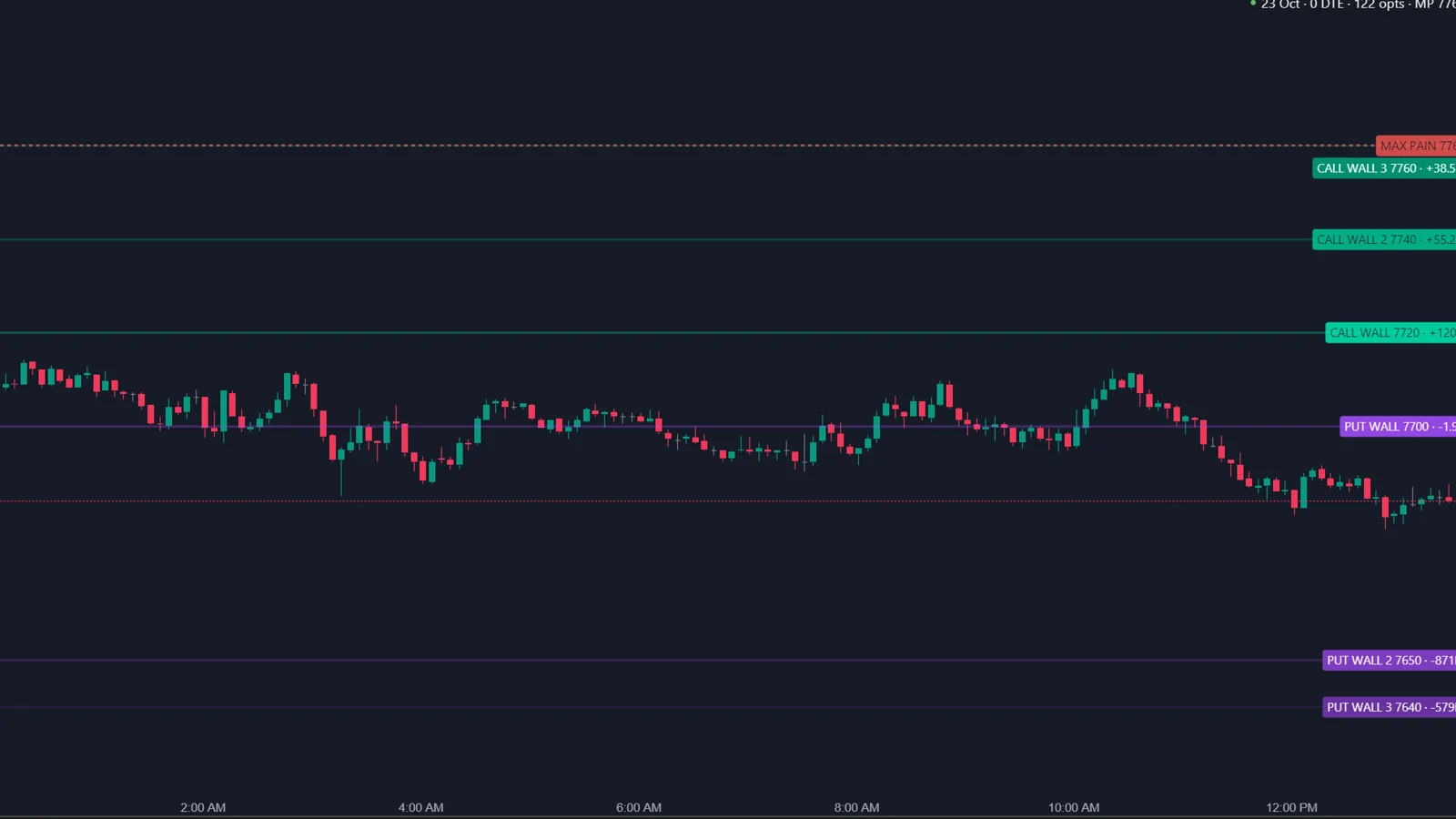
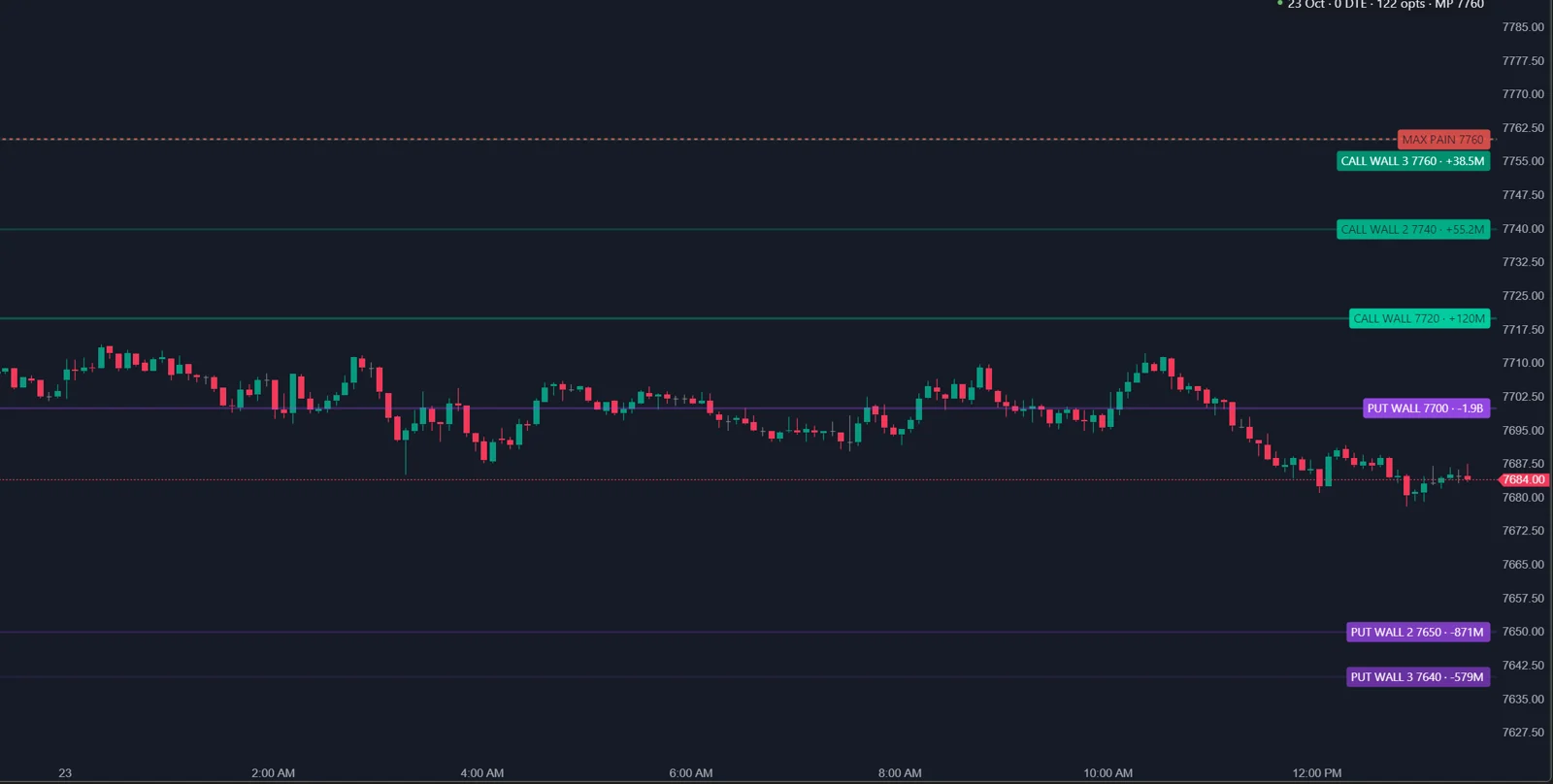
Options Key Levels draws four kinds of option-based lines on the chart: max pain, the call wall, the put wall and optional volume levels. Max pain is the strike with the smallest total payout to option holders at expiration, weighted by open interest. The walls are the strikes with the largest positive and negative gamma exposure from open interest. It analyzes one expiration at a time.
What does Options Key Levels draw?
| Level | Definition in ATAS | Common use |
|---|---|---|
| MAX PAIN | Expiration price with the lowest total intrinsic value paid to option holders, weighted by open interest | Expiration reference, not a target |
| CALL WALL | Strike with the strongest positive gamma exposure in the window | Resistance candidate |
| PUT WALL | Strike with the strongest negative gamma exposure in the window | Support or acceleration candidate |
| Volume levels | Strikes with the largest day volume (optional) | Where today's options trading concentrates |
The value in a wall label shows the strength of the level; larger values usually indicate more important levels. Labels move apart automatically when they overlap, and hovering a line shows an explanatory tooltip.
From practice: in the author's own setup in October 2026, the Options Chain indicators run in ATAS X and receive CME E-mini S&P 500 (ES) options through a Rithmic connection. This is the author's experience, not a statement from ATAS.
How does ATAS calculate max pain?
By testing every listed strike in the window as a possible expiration price and picking the one where option holders would be paid the least.
For each candidate price, the intrinsic value of every call and put is multiplied by its open interest and summed. The candidate with the smallest total is max pain. Because this needs open interest, ATAS does not draw the line at all when the chain provides none. It also uses only one expiration series; ATAS states that max pain from different expirations should not be merged.
How are the call wall and the put wall calculated?
From open interest weighted by gamma. For every strike, call and put exposure are combined into one net value; the largest positive value is the call wall and the largest negative value the put wall.
Two details matter in practice. First, the walls are always calculated from open interest, never from day volume, so that Key Levels and the GEX Profile name the same strikes. Second, the indicator does not force the call wall above price or the put wall below it. If the heaviest call positioning sits below the market, the call wall is drawn there.
Which settings does Key Levels have?
| Setting | What it does |
|---|---|
| Expiration | Which series is analyzed; Auto (nearest) switches after expiration |
| Strikes per side | How many strikes above and below price are included |
| Levels per type | How many top levels of each type are shown |
| Show max pain, call wall, put wall, volume levels | Turns each level type on or off |
| Labels position | Right, left or center |
| Colors and line width | Appearance of each level type |
What does max pain actually tell a futures trader?
Where option holders as a group would lose the most at expiration. It is a count of contracts at a strike, not a force that moves price.
ATAS makes the same point in its Options X-Ray documentation: the count itself does not move price, while market maker hedging around a strong strike can hold price near it into expiration. That is why X-Ray replaces max pain with a Pin level calculated from positioning, and why the two need not match. On any expiration day, treat max pain as a reference line and look at how price behaves around it in the footprint.
What are the limits of Options Key Levels?
- All levels rest on open interest from the previous close. Positions opened today are not included.
- The walls depend on the usual assumption about which side dealers hold. If that assumption is wrong at a strike, the wall can mean the opposite.
- Only the subscribed strike range is included; a strike outside it is not considered.
- Levels recalculate as the option chain updates, so they can shift during the day as gamma changes with price and time.
- After an expiration, Auto (nearest) moves to the next series and the levels can change completely.
How do I use the levels during the session?
ATAS suggests comparing the walls with visible support and resistance and watching, near expiration, whether price reacts at the walls or crosses them with strong volume. In order flow terms: a test of the call wall with aggressive buying absorbed and delta failing to move price fits the level. A test with heavy positive delta, rising volume and no absorption is acceptance, and the next wall or the expected move boundary becomes the more useful reference.
FAQ
Why is there no max pain line on my chart?
Max pain needs open interest. If the chain delivers none, ATAS does not draw it. Check the connection and the expiration.
Can the call wall be below the current price?
Yes. ATAS ranks walls by exposure, not by distance, and does not force the call wall above price.
Why does Key Levels only use one expiration?
Max pain from different expirations should not be merged, because each series settles separately. The GEX Profile can aggregate series; Key Levels cannot.
Is there a Key Levels version that updates intraday?
Options X-Ray: Key Levels recalculates every minute from SPX positioning, but only on ES, MES, SPY and US 500 charts.
This article is educational content, not financial advice.