
Free Futures Trading Course: What You Can Learn and Where It Stops
A free futures trading course can teach you the basics: how contracts work, what margin is, how to size a position and how to place orders in a simulator. It usually stops where the real work starts, which is a method you can test, feedback on your own trades and a fixed path. This guide shows how to learn futures trading for free, where free material runs out, and when a paid course makes sense.
Want to talk it through before you read on? You can book a free call about where you stand and whether the PFT Academy fits you, with no pressure to buy.
What can you learn for free?
You can learn the whole foundation for free: what a futures contract is, how ES and NQ are quoted, what a tick is worth, how margin and leverage work, and how orders behave. Free articles, exchange education pages, broker academies, videos and simulators cover this well.
- Contract basics. Size, tick, tick value, trading hours and expiry.
- Margin and leverage. What a deposit is, and why a small move is a big move in your account.
- Order types. Market, limit and stop orders, and what happens when the market is fast.
- Risk arithmetic. Dollars at risk, position size and a daily loss limit.
- Simulator practice. Placing trades with no capital at risk.
As a worked example, with $200 of risk and a 10-point stop on ES, one MES contract risks $50, so four MES contracts risk $200. One standard ES contract with the same stop would risk $500. Take the contract values from the official specifications.
What is a good free futures trading course made of?
A good free futures trading course is structured, says who made it and where it stops, and teaches risk before entries. Check these points before you spend time on it.
- It starts with contracts and risk, not with a strategy.
- It uses real contracts such as ES, NQ, MES and MNQ.
- It says what it does not cover.
- It tells you who made it.
- It does not ask for money in the middle of the lessons, and it does not promise income.
Free material is also the best test for a paid course. If a provider's free guides are clear and honest, the paid lessons are more likely to be.
Where do free courses stop?
Free courses usually stop at the method, the feedback and the structure. You get the vocabulary, but not a tested way to use it, nobody who looks at your trades, and no fixed order that keeps you from jumping between topics.
- No tested method. Many free videos show a setup. Few show the context around it, the stop logic and the review of results.
- No path. A playlist is not a curriculum. Without an order, beginners collect ideas and never finish a system.
- No review loop. Free material rarely makes you journal every trade and check your plan adherence, which is where improvement comes from.
- No checkpoints. Nothing tells you whether you understood a lesson before you move on.
- Hidden cost. A free course may need a paid platform, paid data or a paid indicator set. Check this before you start.
What are the red flags in a free course?
The main red flag is a free course that is really a sales funnel for signals or an income promise.
- Signal selling. The free part ends where the paid signals begin.
- Income promises. "Become profitable" or "make X per month" is a claim nobody can honestly make.
- Results as proof. A profit screenshot says nothing about your outcome.
- Fake urgency. Countdown timers that restart.
- An anonymous teacher. If you cannot find out who teaches, you cannot judge it.
- Account opening as the real goal. If the lessons mostly push you to open an account with a partner, ask who earns from it.
When does a paid futures trading course make sense?
A paid course makes sense when you have learned the basics, you know which platform you use, and what you are missing is order, a tested method and review. If you are still deciding whether futures are for you, stay with free material.
- You understand tick value and margin, and have placed trades in a simulator.
- You keep jumping between methods and cannot finish a system.
- You trade, but have no written plan and no measured results.
- You can afford the course, the platform and the data without touching your trading capital.
Before you pay, apply the same checklist to any course: a visible lesson list, a named teacher, honest risk language, stated terms and a way to test the teaching first.
How does the PFT Academy fit in?
The PFT Academy is our paid course, and it is built for the step after the free basics: a fixed order, checks, a written plan and a review loop. We built it, so we describe it only with what our website states.
- 240+ videos in 8 phases: Foundation, Analysis, Setup, Volume, Context, Plan, Review and Upgrades.
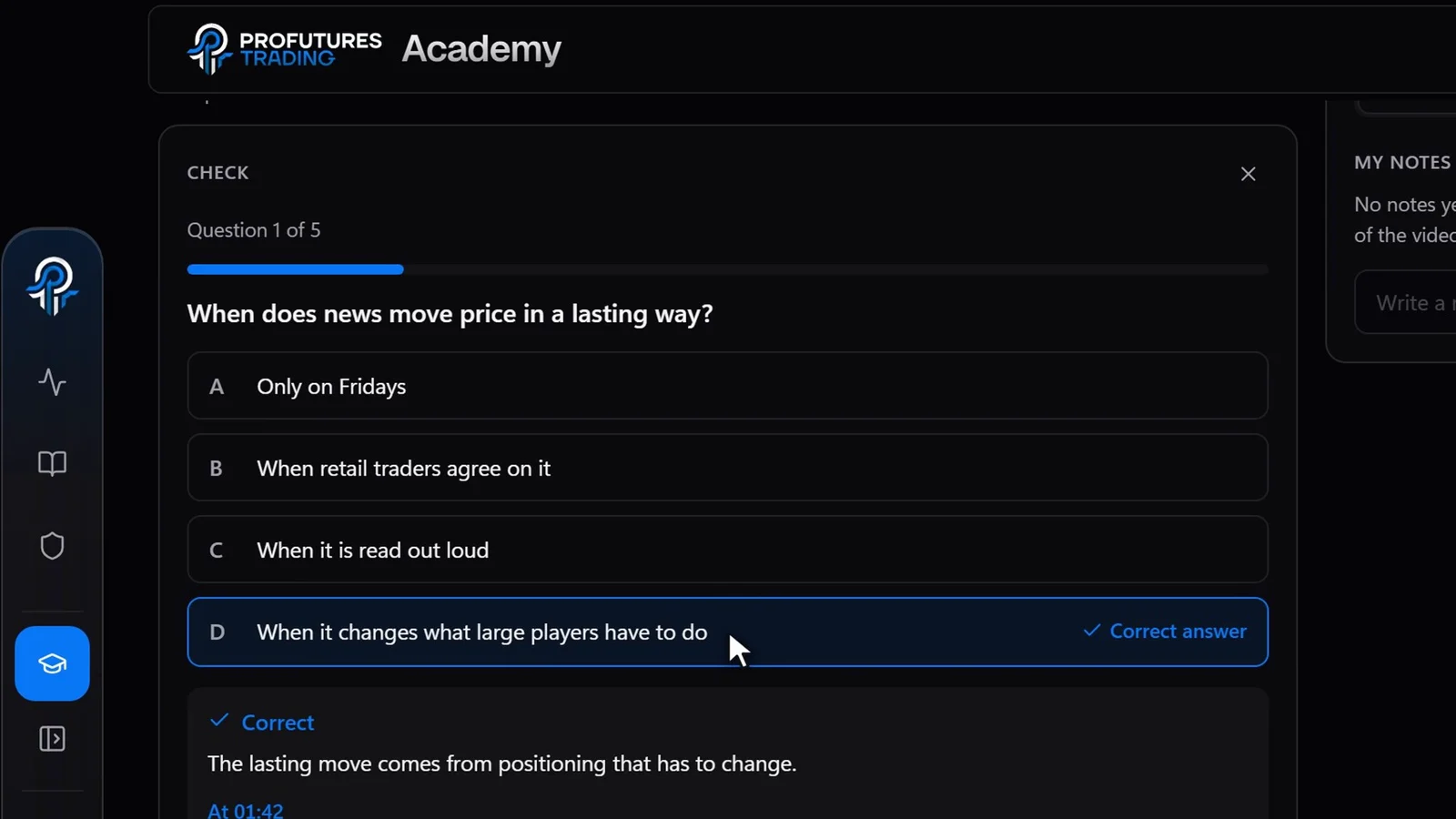
- A short check after every lesson. The next lesson opens once you pass it, and your progress is saved.
- Set-up of ATAS, your data feed and a clean order flow workspace.
- A practice step with demo and replay before real money.
- A Plan phase that ends in a written trading plan, and a Review phase on journaling every trade.
- The PFT indicators and the PFT Terminal are included for every student, as the course page states.
The course is taught by Phil Wasmuth, named on our site as founder and head trader. ProFuturesTrading was founded by Phil Wasmuth and co-founder Ulrich Gruebler. Phil is a full-time futures trader with more than eight years in the markets. He started with CFDs and binary options and lost a lot of money. He then sat down, worked on his risk management and his skills, and built up consistently from there. We also publish free guides, so you can test our teaching before you pay anything.
It is built around ATAS and video lessons, so it does not fit you if you trade on another platform or want live coaching. The page states there are no signals and no promise of profits. Your first step is a free call about where you stand and whether the course fits, with no pressure to buy.
FAQ
Is there a free futures trading course?
Yes, there is free material for the basics: contracts, margin, risk and order types. Exchange education pages, broker academies, free articles and videos cover them. Free material rarely includes a tested method, feedback on your trades or a fixed path.
Can I learn futures trading for free?
You can learn the foundation for free and practise in a simulator. Learning to trade with a plan and a review loop takes more structure, which a paid course or a lot of self-discipline provides.
What should a free futures trading course teach first?
Contract specifications, margin, order types and risk per trade, in that order, before any strategy.
Is a free course enough to start trading futures?
It is enough to understand the basics and to start in a simulator. Before you use real money, you also need a written plan, a journal and a size you can afford to lose.
When is a paid futures trading course worth it?
When you know the basics and what you miss is order, a tested method and review. If you are still deciding whether futures are for you, stay with free material.
Does the PFT Academy offer a free first step?
The Academy is paid. The free first step is a call about where you stand and whether the course fits, with no pressure to buy, plus our free guides on order flow and volume profile.
Ready for the next step?
If you want to see whether the PFT Academy is the right fit, book a free call. We look at where you stand, answer your questions about the course and you decide afterwards, with no pressure to buy.
This article is educational content, not financial advice. Trading futures involves substantial risk of loss.