

Best Futures Trading Courses for 2027: How to Choose One
The best futures trading course for you is the one that teaches contract mechanics, risk and position sizing, a method you can write down and a way to review your own trades, and that shows its lessons before you pay. This guide gives you a checklist to judge any futures trading course, the red flags to avoid, and a learning order for anyone who wants to learn futures trading. At the end we describe our own course, the PFT Academy, openly, so you can hold it against the same checklist.
One disclosure up front: we built the PFT Academy, and it is the only course described here. We describe it only with what our own website states.
Want to talk it through before you read on? You can book a free call about where you stand and whether the PFT Academy fits you, with no pressure to buy.
What does a good futures trading course contain?
A good futures trading course is a chain of nine blocks, and each one depends on the one before it. A gap anywhere weakens everything after it.
1. Contract mechanics and costs
You cannot size a trade without knowing what a point is worth, so a course should make this automatic with real contracts:
- E-mini S&P 500 (ES): $50 per index point, tick size 0.25, so $12.50 per tick. Micro E-mini (MES): $5 per point, $1.25 per tick.
- E-mini Nasdaq-100 (NQ): $20 per point, $5 per tick. Micro (MNQ): $2 per point, $0.50 per tick.
Take these figures from the official contract specifications before you rely on them. It should also cover margin, contract months and rollover, trading hours, and commissions and fees, because costs decide whether a small edge survives.
2. Risk and position sizing
This block comes before any entry idea. You decide your risk in dollars first and let the stop distance set the size, not the other way round.
An illustration, not a recommendation: if you accept $200 of risk and your stop is 10 points away on ES, one MES contract risks $50, so four MES contracts risk $200. On NQ, a 20-point stop is $40 per MNQ contract, so five MNQ contracts risk $200. One standard ES contract with the same 10-point stop would risk $500, which is why many beginners start with micros. The block should also cover a daily loss limit and what you do after a string of stops.
3. How the market works and how price moves
Before a method comes the question of who is on the other side. A good course explains market participants, why price moves and how the market auctions between buyers and sellers. Only then does it teach one way to read it: price action, volume profile or order flow. Ask which one it teaches, and whether the examples use ES and NQ.
4. Context and location
An entry only means something at a relevant place. Look for lessons on trend and range phases, the previous day's high, low and value area, and how the session opens. A signal without context is a coin flip.
5. Platform, data and workspace
A course should show you the exact setup: platform, data feed, which windows to open and what each indicator shows. Check which data it requires, because depth of market data is usually a separate subscription. A clean workspace is part of the method, since too many lagging indicators only add noise.
6. A practice phase before real money
A simulator and replay let you apply the method with no capital at risk. The course should say what to practise, for how long, and what you must show before you move on. Simulated fills can be more optimistic than live fills, and practice money does not test your nerves.
7. A written trading plan
Rules written before the session replace decisions made under pressure. A plan names the instrument, the hours, the setups you take, the stop and target logic, the risk per trade, the daily limit and when you stop. A course should make you write it, not just show you someone else's.
8. Journaling and a review loop
This is where most courses end too early. A good one teaches you to log every trade with the reason for entry, the location, whether you followed your plan and the result in R, your risk unit. Then you review it on a schedule.
A small calculation shows why. If you win 40% of trades with an average winner of 1.5R and lose the other 60% at 1R, the expectancy is 0.4 x 1.5 - 0.6 x 1 = 0, before fees. You only learn this from your own numbers.
9. Feedback, questions and updates
Markets change, so a course should be maintained, with new material added and old material revised. You also need a way to ask questions: a community, a support channel or a call. A course that never answers is a video library.
How do you judge a futures trading course before you pay?
Run the course through eleven questions. If it fails several, keep looking.
- Can you see a lesson list before you pay?
- Do the instruments match yours, such as ES, NQ or their micro versions?
- Does it name the platform and data feed, and what they cost?
- Is the format clear: self-paced video, live sessions or mentoring?
- Does it state who it is for: beginners, experienced traders or both?
- Are price and inclusions clear, including any software that comes with it?
- Have you read the refund and contract terms before checkout?
- Does it use honest risk language: futures are leveraged and losses can exceed your deposit?
- Can you test the teaching first, with a free preview, free articles or a call?
- Is there a way to practise: quizzes, a plan template, a journal, a demo and replay phase?
- Can you check who teaches it and what that person claims?
What are the red flags in a futures trading course?
The main red flags are signal selling, income promises and a hidden method. One flag is a reason to ask a question. Several together are a reason to leave.
- Signal selling presented as education. You pay for someone else's entries and learn nothing about managing a loss.
- Income promises. Phrases such as "become profitable" or "make X per month" are claims nobody can honestly make.
- Results as proof. A screenshot of the owner's account says nothing about what you will earn. If results are shown, look for every month including the losing ones, the source of the numbers and a clear disclaimer.
- No risk section. A course that goes straight to the strategy leaves out what keeps you in the game.
- No practice phase. Sending you to a live account in week one skips the step that costs nothing.
- Fake urgency. Restarting countdown timers and "only a few seats left" without a real reason.
- A secret method. If you cannot see what is taught before paying, you cannot judge it.
- An anonymous teacher. If you cannot find out who teaches, you cannot judge the claims.
The US regulator for futures markets publishes guidance on how to spot fraud before you hand money to anyone.
In which order should you learn futures trading?
Learn the machine before the method: contracts and risk first, then market structure, then one way to read price, then a written plan and a review loop. Skipping ahead to entries is the most common reason beginners lose their first account.
- Contract mechanics, margin and costs.
- Risk per trade, position size and a daily loss limit.
- Market participants and market structure.
- One method on one instrument, for example order flow on ES.
- Practice in a simulator and in replay.
- A written plan and a journal from the first trade.
- A scheduled review of your own numbers.
Which format fits, and what does a futures course cost?
Self-paced video suits people who work alone and need checkpoints. Live sessions add structure and real-time questions at fixed times. Mentoring gives feedback on your own trades and works best once you already have a method to review. Free articles, videos and calculators are a good way to test a topic first.
The course is only one line in the budget. Add the platform, the market data (market data for CME futures is usually a separate monthly fee from your data provider), any indicators or tools the method depends on, and your trading capital. If you plan to use a prop firm evaluation, read its rules separately, starting with our explainer on the consistency rule. Write the total down before you decide.
Why is the PFT Academy a fit for some traders?
The PFT Academy is a fit if you want to learn futures day trading through order flow, in a fixed order, with the tools included and a plan you write yourself. We describe it here with its reasons and its limits, so you can decide.
Who teaches it, and why does that matter?
The course is taught by Phil Wasmuth, named on our site as founder and head trader and as the provider in our terms. ProFuturesTrading was founded by Phil Wasmuth and co-founder Ulrich Gruebler. Phil is a full-time futures trader with more than eight years in the markets. He started with CFDs and binary options and lost a lot of money. He then sat down, worked on his risk management and his skills, and built up consistently from there.
We mention it for one reason: the lessons come from someone who went through the mistakes himself, which is why the course puts risk and review before entries.
Phil publishes his track record month by month. Across all 14 traded months since May 2025, 13 were positive and 1 was negative, for a total of +$161,584. Here is every traded month, including the losing one.
| Month | Result (USD) |
|---|---|
| May 2025 | -$7,560 |
| October 2025 | +$4,762 |
| November 2025 | +$2,096 |
| December 2025 | +$24,125 |
| January 2026 | +$25,621 |
| February 2026 | +$36,481 |
| March 2026 | +$2,501 |
| April 2026 | +$14,165 |
| May 2026 | +$1,360 |
| June 2026 | +$18,175 |
| July 2026 | +$11,745 |
| August 2026 | +$6,992 |
| September 2026 (as of Sep 24) | +$1,122 |
| November 2026 (as of Nov 23) | +$20,000 |
Phil's personal real-money trading account, results as recorded in his trading journal, in USD. Every traded month is shown, including losing months; June to September 2025 and October 2026 had no trading. Past results are not indicative of future results and are not a promise; individual results vary and losses are possible. They are not a statement about what students will earn.
What do you get, mapped against the nine blocks?
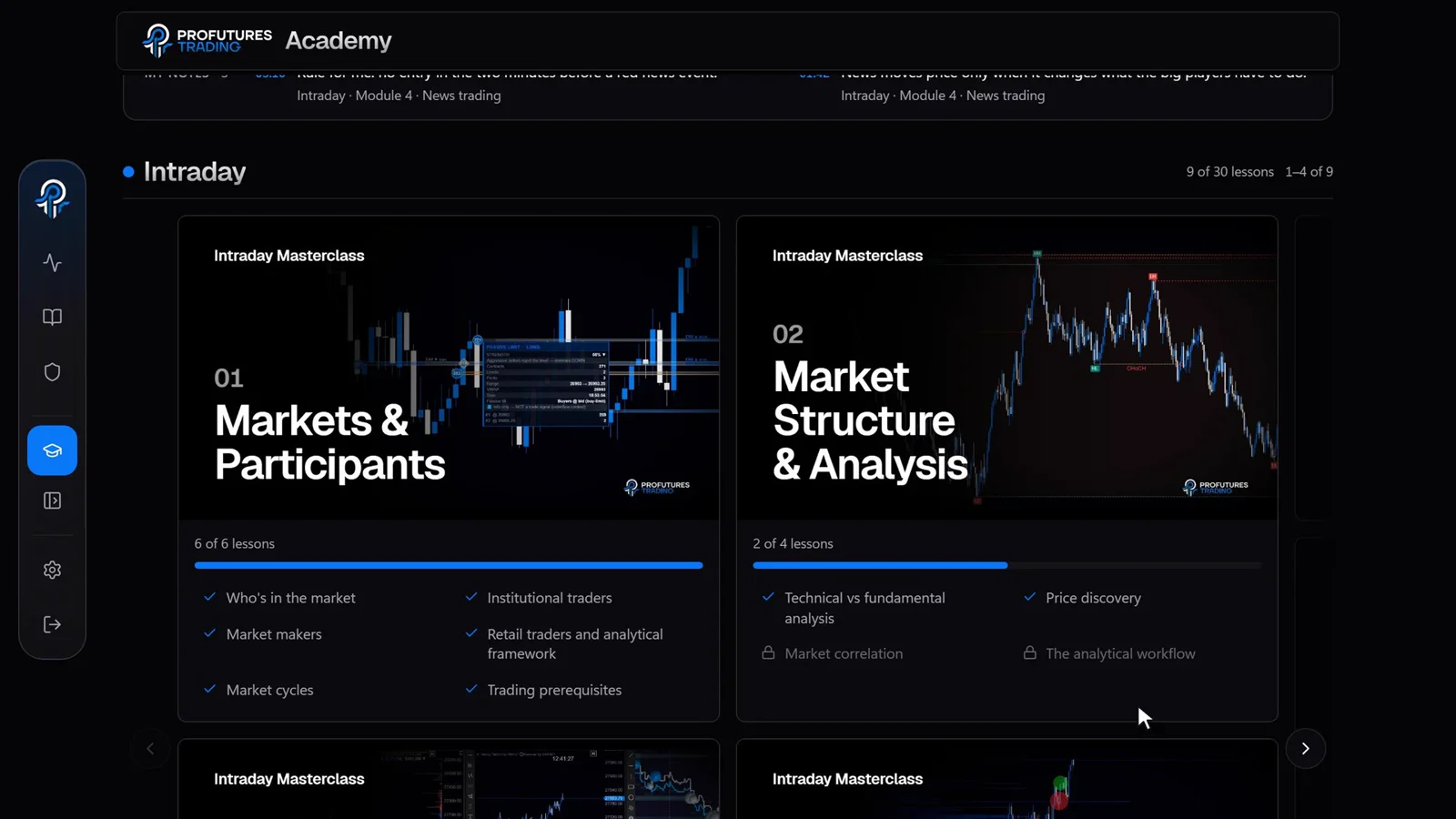
- 240+ videos in 8 phases: Foundation, Analysis, Setup, Volume, Context, Plan, Review and Upgrades.
- The Foundation phase covers who trades futures, why price moves and what you need before your first trade.
- A short check after every lesson. The next lesson opens once you pass it, and your progress is saved.
- A set-up step for ATAS, your data feed and a clean order flow workspace.
- A practice step with demo and replay before real money.
- A Plan phase that ends in a written trading plan, and a Review phase on journaling every trade.
- Constant updates: new video material is added as markets change.
Which tools do students get?
The PFT indicators and the PFT Terminal are included for every student, as the course page states. The indicators are order flow tools for ATAS, and the Terminal is a trading journal that imports your trades so you can check each one against your plan.
How are you guided?
You work through the lessons module by module, pass the checks, set up your chart, write your plan, practise and review. The first step is a free call about where you stand and whether the course fits, with no pressure to buy. The course page states there are no signals and no promise of profits.
Who is it not for?
It is built around ATAS and video lessons, so it does not fit you if you trade on another platform or want live coaching. It is not for anyone looking for guaranteed profits, signals to copy or shortcuts. Ask for the lesson list on the first call and judge the teaching against the checklist above.
What can no course do?
A course can shorten the learning curve. It cannot supply discipline, and it cannot remove risk.
- Futures are leveraged. A small move in the contract is a large move in your account, and losses can exceed your deposit.
- Many day traders lose money. A study of Brazilian day traders in the mini-index futures market found that 97% of those who kept trading for more than 300 days lost money, net of fees. It covers one market and one group, but it is a reason to treat any promise to the contrary as a red flag.
- Someone else's results are not yours. A teacher's record, ours included, says nothing about your outcome.
- Prop firms add rules, not skill. An evaluation fee does not replace a tested method.
FAQ
What is the best futures trading course?
There is no single best course, because the right one depends on your platform, budget and experience. Check that it teaches contract mechanics, risk and position sizing, a written plan and a review loop, shows its lesson list before you pay and states its terms. Use the checklist above to judge any course.
What should a futures trading course include?
Contract mechanics and costs, risk and position sizing, how price moves, context and location, a platform and data setup, a practice phase, a written plan, a journal and review loop, and a way to ask questions and get updates.
How do I learn futures trading from scratch?
Start with contracts, margin and risk, then learn one method on one instrument, practise in a simulator and replay, and write a plan and journal every trade. Free articles and the CME education pages cover the basics, and a structured course adds order and review.
Who teaches the PFT Academy?
Phil Wasmuth, named on our site as founder and head trader. The course page describes him as a full-time futures trader with more than eight years in the markets.
What is included in the PFT Academy?
240+ videos in 8 phases, a check after every lesson, an ATAS set-up phase, a practice step, a written trading plan and a review phase. The PFT indicators and the PFT Terminal are included for every student.
Can a futures trading course make me profitable?
No honest course can promise that. A course can teach structure, risk management and how to review your trades. Results depend on your decisions, discipline and capital.
Ready for the next step?
If you want to see whether the PFT Academy is the right fit, book a free call. We look at where you stand, answer your questions about the course and you decide afterwards, with no pressure to buy.
This article is educational content, not financial advice. Trading futures involves substantial risk of loss.