

Futures Trading Course for Beginners: How to Learn Futures Trading
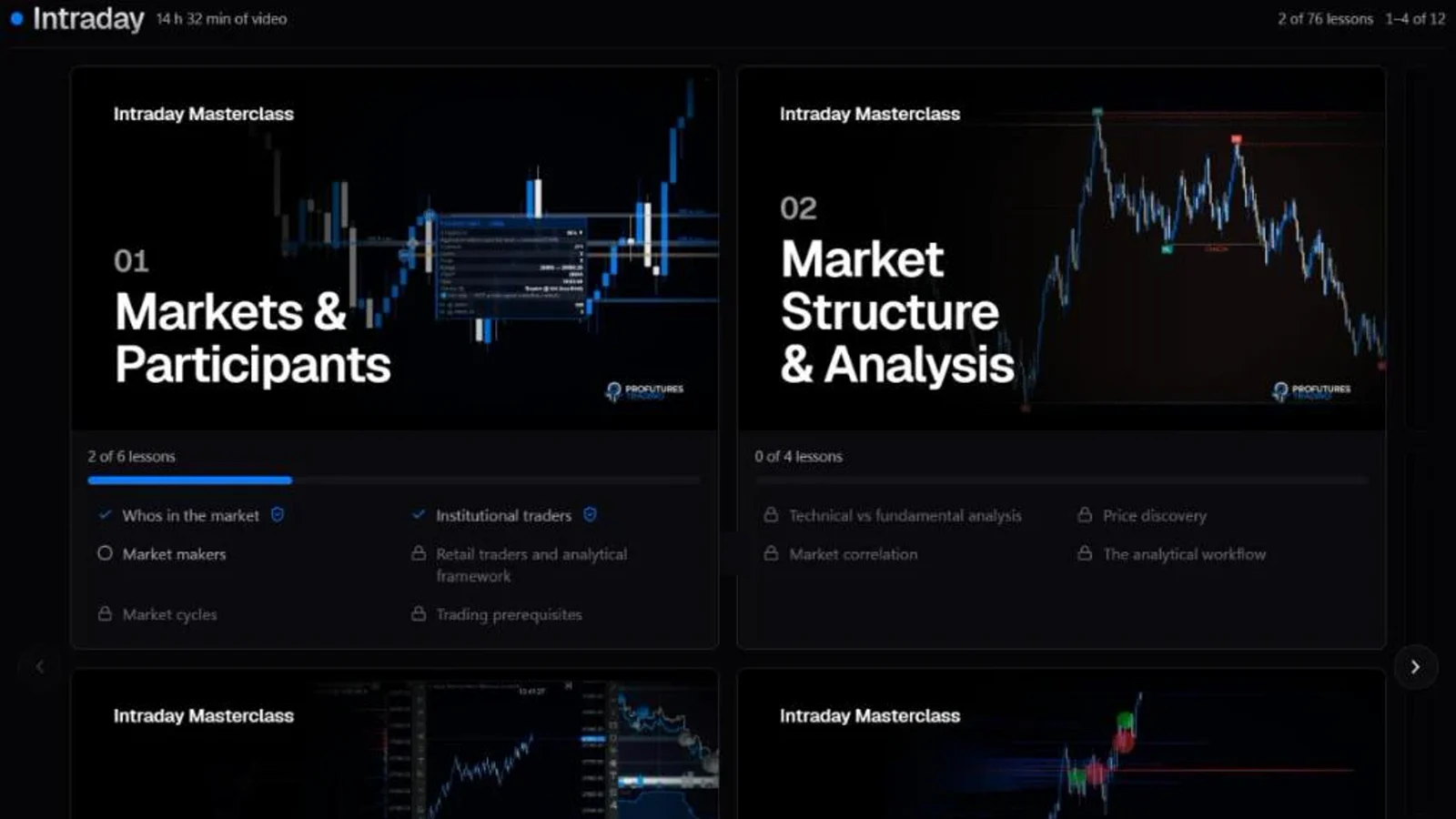
To learn futures trading as a beginner, start with what you are trading and how you can lose money, before any strategy. That means contract specifications, risk and position sizing, margin and order types, a practice phase on a simulator, and a journal. A futures trading course for beginners should teach exactly that order. This guide shows what to learn first, what a good beginner course contains, what it costs to start and how our own course, the PFT Academy, works, which we disclose below.
Want to talk it through before you read on? You can book a free call about where you stand and whether the PFT Academy fits you, with no pressure to buy.
What are futures, in plain terms?
A futures contract is a standardized agreement to buy or sell an asset at a set price on a future date. Day traders rarely hold it that long: they buy and sell during the session and close before they finish, so they trade the price movement of the contract.
- Leverage. You post a margin deposit that is a fraction of the contract's value. Gains and losses are calculated on the full contract value, so small moves have large effects on your account.
- Standardization. Each contract has a fixed size, tick size, tick value and expiry. The E-mini S&P 500 (ES) and the E-mini Nasdaq-100 (NQ) are among the most traded futures, and both have micro versions (MES and MNQ).
Futures trading carries substantial risk of loss, and losses can exceed the amount you deposited. Everything below assumes you accept that.
What should you learn first when you learn futures trading?
Learn the machine before the method: risk, contract specifications and position sizing come first, a trading method second. A good beginner course follows this order, and you can use it as a checklist.
1. Risk first
Before any entry idea, decide what you can lose per trade, per day and in total. The stop belongs to the plan before the entry, not after. A course that opens with "a strategy that works" and leaves this out skips the part that protects your account.
2. Contract specifications, with real numbers
- ES: $50 per point, tick size 0.25 ($12.50 per tick). MES: $5 per point ($1.25 per tick).
- NQ: $20 per point ($5 per tick). MNQ: $2 per point ($0.50 per tick).
A good course drills this until it is automatic, and tells you to take the figures from the official contract specifications.
3. Position sizing
Let your risk set the size. An illustration, not a recommendation: with $200 of risk and a 10-point stop on ES, one MES contract risks $50, so four MES contracts risk $200. One standard ES contract with the same stop would risk $500. That gap is why many beginners start with micros: mistakes cost less while you learn.
4. Margin and order types
What your broker requires, what happens if your account falls below it, and how market, limit and stop orders behave when the market moves fast.
5. Sessions, costs and rollover
When the market is active, what commissions and fees do to a small edge, and what happens when a contract expires and you move to the next one.
6. A practice phase
A simulator and replay let you place trades against live or recorded prices with no capital at risk. A good course tells you what to practise and what you must show before you trade real money. Judge the length by your own journal, not by a fixed number of days. Practice money does not test your nerves, so treat the first live size as small.
7. A journal from the first trade
Write down every trade, including simulated ones: the reason for entry, the location, whether you followed your plan and the result in R, your risk unit. With a 40% win rate, an average winner of 1.5R and a 60% rate of 1R losers, the expectancy is 0.4 x 1.5 - 0.6 x 1 = 0 before fees. You only discover numbers like this from your own record.
8. One way to read the market
Pick one method, such as price action, volume profile or order flow, and one instrument, and stay with it long enough to review it. Changing methods weekly means you never learn which one works for you.
9. A written plan
One page: when you trade, which setups you take, where your stop goes, your risk per trade, your daily loss limit and when you stop. Writing it yourself matters more than copying one.
10. Questions and updates
Beginners get stuck on small things. A good course gives you a place to ask and keeps its material current as markets change.
How much does it cost to start?
The course is only one part of the cost. Plan for the course, a platform, market data, any tools the method depends on, and funds for trading.
- The course. Prices range from free material to programmes costing thousands, and some pages show no price at all.
- A platform. Some are free, some are paid, and some courses are built around one platform. Check this before you buy.
- Market data. Market data for CME futures is usually a separate monthly fee from your data provider. Ask your broker and platform what you need.
- Tools or indicators, if the method depends on them. Check whether they are included or a separate subscription.
- Funds for trading. An own account needs margin plus a buffer for losses. A prop firm evaluation charges fees and sets rules on drawdown and consistency, which you must read yourself.
Count the full cost first, and only risk money you can afford to lose.
What are the red flags in a beginner course?
- Signal selling presented as education. Copying entries teaches you nothing about managing losses.
- Income promises. "Become profitable", "quit your job" and "make X per month" are claims nobody can honestly make.
- No risk section and no practice phase. The two steps that protect you are missing.
- A secret method. If you cannot see what is taught before you pay, you cannot judge it.
- Fake urgency. Restarting countdown timers and "only a few seats left" without a reason.
- Results as proof. An owner's profit screenshot says nothing about your outcome.
- An anonymous teacher. If you cannot find out who teaches, you cannot judge their claims.
How do you choose a futures trading course for beginners?
Choose one that covers the basics in order, shows its lessons before you pay and states its terms. Use this short checklist.
- It covers risk, contract specifications, position sizing, margin and order types before any strategy.
- You can see the lesson list before you pay.
- It tells you which platform and data feed you need.
- It has a practice element: demo and replay, quizzes, a journal or a plan template.
- There is free material to test the teaching, or a refund policy you have read.
- It says plainly that futures involve a substantial risk of loss and does not promise income.
- It states who it is for and whether you need experience.
- You can find out who teaches it and check what that person claims.
How does the PFT Academy work for a beginner?
The PFT Academy takes you through the same order as this guide, one module at a time, and the course page states that no experience is needed. We built it, so take this section with that in mind: everything below is what our website states.
What does a first week look like?
You start in the Foundation phase, which covers who trades futures, why price moves and what you need before your first trade. After every lesson there is a short check, and the next lesson opens once you pass it, so nothing is skipped. Your progress is saved, and you can see which lessons you finished and where you continue.
That is the idea behind the sneak peek above: you always see the next step, and the course keeps you in order instead of letting you jump between topics.
Which phases follow?
- 240+ videos in 8 phases: Foundation, Analysis, Setup, Volume, Context, Plan, Review and Upgrades.
- The Setup phase covers ATAS, the data feed and a clean order flow workspace.
- A practice step with demo and replay before real money.
- A Plan phase that ends in a written trading plan, and a Review phase on journaling every trade and checking plan adherence.
- Constant updates: intraday is available now, with scalping and options in development, as the homepage lists.
Which tools come with it?
The PFT indicators and the PFT Terminal are included for every student, as the course page states. The indicators are order flow tools for ATAS, and the Terminal is a trading journal that imports your trades, so you check each one against your plan from the first day.
How are you guided, and who teaches?
The course is taught by Phil Wasmuth, named on our site as founder and head trader. ProFuturesTrading was founded by Phil Wasmuth and co-founder Ulrich Gruebler. Phil is a full-time futures trader with more than eight years in the markets. He started with CFDs and binary options and lost a lot of money. He then sat down, worked on his risk management and his skills, and built up consistently from there, which is why the course starts with risk. His results are published on the homepage, every traded month including the losing ones, from his own account. Past results are not indicative of future results, and individual results vary. Your first step is a free call about where you stand and whether the course fits, with no pressure to buy.
It is built around ATAS and video lessons, so it does not fit you if you trade on another platform or want live coaching. The page states there are no signals and no promise of profits.
What does a simple first 30 days look like?
A first month is a learning plan, not a return target: contracts and risk, platform, one method, then plan and journal.
- Week 1: contracts and risk. Learn tick value, point value and margin for ES and MES. Write down what one contract loses per point.
- Week 2: platform and charts. Set up a simulator account and practise placing and cancelling orders.
- Week 3: one simple method. Pick one way to read the market and one instrument.
- Week 4: plan and journal. Write your one-page plan and keep a journal from the first simulated trade.
After that, review your journal before you add size or a live account.
What are the common beginner mistakes?
- Trading too large. Several contracts when the account supports one micro.
- Skipping the stop. Deciding where you are wrong after you entered.
- Changing methods weekly. Every new video becomes a new system.
- Buying signals. Copying entries does not build your own skill.
- Treating a prop firm evaluation as a shortcut. It adds rules on top of the skill you still need.
- Never reviewing. Without a journal you repeat the same mistake for months.
FAQ
What is the best futures trading course for beginners?
There is no single best option. A good beginner course covers risk, contract mechanics, position sizing, margin and order types before strategy, shows its lessons before you pay, includes a practice phase and states its terms.
How do I learn futures trading?
Learn contracts, margin and risk first, then one method on one instrument, practise in a simulator and replay, and keep a written plan and a journal from the first trade. Free articles cover the basics, and a structured course adds order and review.
Who teaches the PFT Academy?
Phil Wasmuth, named on our site as founder and head trader. The course page describes him as a full-time futures trader with more than eight years in the markets.
Can I learn futures trading for free?
For the basics, yes. Free articles, videos and calculators can teach contracts, margin and risk. A paid course mainly adds structure, depth and a defined path.
How much money do I need to start trading futures?
It depends on your broker's margin requirement for the contract you trade, plus a buffer for losses, platform and data fees. Micro contracts have lower margin. Check the exact figures with your broker and the CME Group before you fund an account.
Should beginners trade ES or micro contracts?
Many beginners start with micros such as MES, because each point is worth a fraction of an E-mini point. Check the current contract specifications on the CME Group site.
How long does it take to learn futures trading?
There is no fixed answer, and no course can promise one. A common approach is several weeks of learning and simulator practice before any real money, followed by a small size and a journal review.
Is futures trading risky for beginners?
Yes. Futures are leveraged, and losses can exceed the deposit. That is why risk management and a practice phase come before any strategy.
Ready for the next step?
If you want to see whether the PFT Academy is the right fit, book a free call. We look at where you stand, answer your questions about the course and you decide afterwards, with no pressure to buy.
This article is educational content, not financial advice. Trading futures involves substantial risk of loss.