

How to Trade Futures: Beginner's Guide to ES, NQ and MES
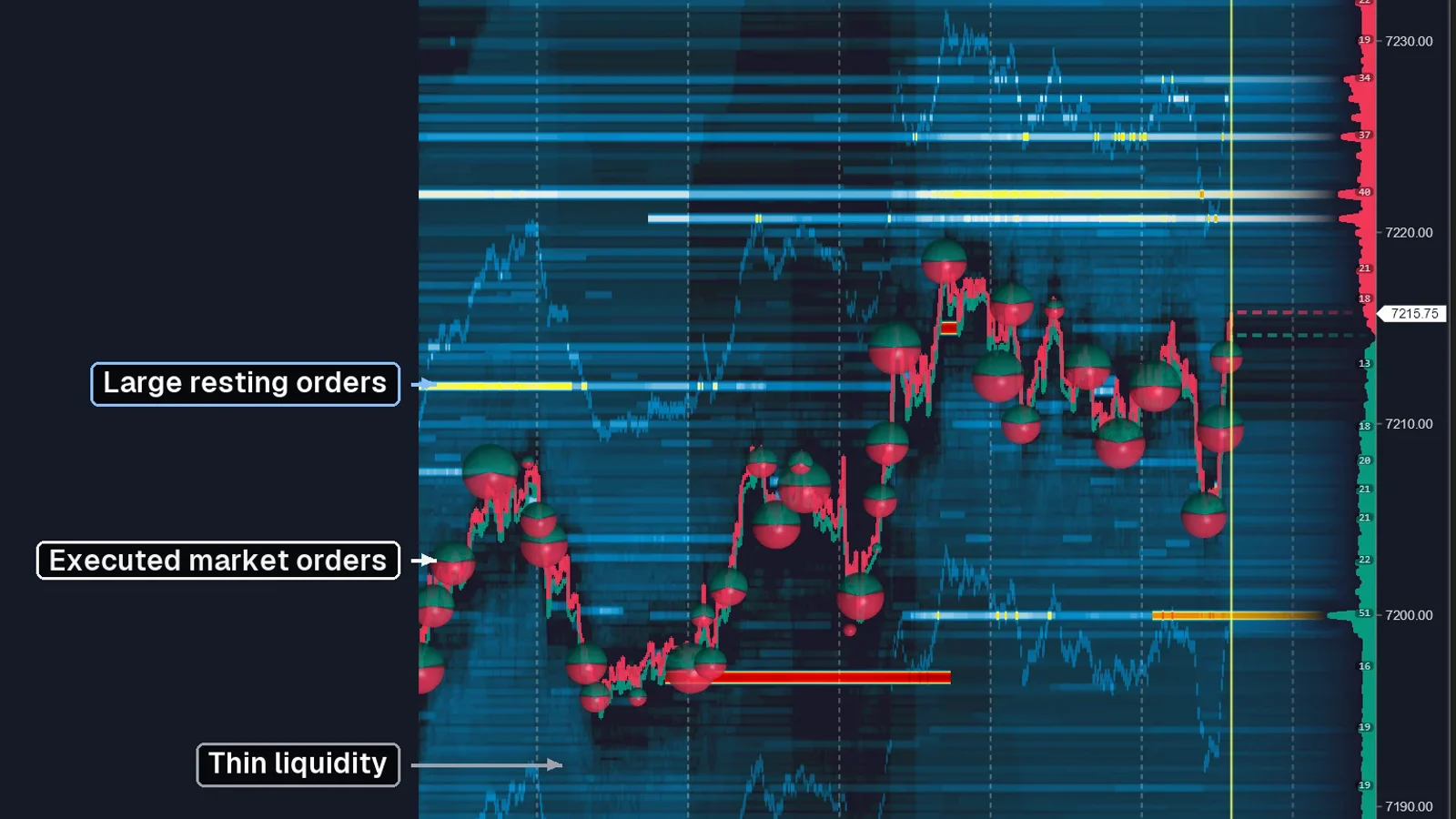
To trade futures, you need to understand four things before you place an order: what the contract is, what one tick is worth, how margin and leverage work, and when the market is open. This guide explains them for the contracts most day traders start with: the E-mini S&P 500 (ES), the E-mini Nasdaq-100 (NQ) and their Micro versions (MES and MNQ). It then covers a first trade, the order flow view of the chart, costs and risk rules.
What is a futures contract?
A futures contract is a standardised agreement to buy or sell an underlying asset at a set price on a set date. For ES and NQ the underlying is a stock index, the S&P 500 and the Nasdaq-100. The exchange, the CME Group, defines everything about the contract, so every ES contract is identical to every other.
A few terms carry most of the weight:
- Underlying. The index the contract follows.
- Expiry. Futures expire on a fixed cycle. Day traders do not hold to expiry. They trade the most active contract and move to the next one when volume shifts, which is called the roll. Your platform shows the active expiry.
- Tick. The smallest price move the contract can make. For ES, NQ, MES and MNQ it is 0.25 index points.
- Tick value. What one tick is worth in dollars. This is the number you multiply by to know your risk.
- Point value. What one full index point is worth in dollars. It is four ticks for these contracts.
You do not need to own the underlying, and as a day trader you will close the position the same day. What you trade is the price movement of the contract.
What are the sizes and tick values of ES, NQ, MES and MNQ?
Each Micro contract is one tenth of its E-mini counterpart. The tick is the same 0.25 points, so the dollar value per tick is ten times smaller.
| Contract | Index | Multiplier per point | Tick size | Value per tick |
|---|---|---|---|---|
| ES (E-mini S&P 500) | S&P 500 | $50 | 0.25 points | $12.50 |
| MES (Micro E-mini S&P 500) | S&P 500 | $5 | 0.25 points | $1.25 |
| NQ (E-mini Nasdaq-100) | Nasdaq-100 | $20 | 0.25 points | $5.00 |
| MNQ (Micro E-mini Nasdaq-100) | Nasdaq-100 | $2 | 0.25 points | $0.50 |
Contract sizes of ES, NQ, MES and MNQ according to CME Group contract specifications, retrieved 28 November 2026. Check the current figures on the CME Group website before you trade.
A worked example makes it concrete. If you buy one ES contract and price rises 4 points, that is 16 ticks of $12.50, or $200. If it falls 4 points, you lose $200. In MES the same 4 points are 16 ticks of $1.25, or $20. The market moved identically, only the exposure is different.
This is why many beginners start with micros. You can practise the same chart reading with a fraction of the dollar risk per tick. NQ usually moves in larger point ranges than ES and each point is worth more, so its swings in dollars per contract are larger. Compare both in a replay before you choose.
How do margin and leverage work?
Margin in futures is a good-faith deposit your broker holds so that you can open a position. It is not a down payment and it is not the price of the contract. Because you control a large contract value with a small deposit, futures are leveraged: gains and losses are both magnified relative to the deposit.
Two kinds of margin matter. The initial margin is what you need in the account to open a position. The maintenance margin is the minimum you must keep while the position is open. Each broker sets its own levels and they change, so take the current figures from your broker, not from an article.
What matters for risk is not the margin number, it is the loss you accept per trade. A margin requirement tells you what the broker needs. Your own risk limit tells you how much of your account you are willing to lose. Size from the second, never from the first.
When can you trade futures?
According to CME Group, trading on the Globex electronic platform runs from Sunday 6:00 p.m. to Friday 5:00 p.m. Eastern Time, with a daily maintenance break from 5:00 p.m. to 6:00 p.m. ET. That is almost 24 hours a day on weekdays.
Most day traders do not trade all of it. Two sessions matter:
| Session | What it is | What to expect |
|---|---|---|
| Overnight (Globex) | Trading from the 6:00 p.m. open until the U.S. stock market opens | Thinner volume, price can drift or react to overseas news |
| Regular trading hours (RTH) | The U.S. stock market session, which starts at 9:30 a.m. | Highest participation, faster moves, most order flow signals |
The two sessions most ES and NQ day traders separate. Times in New York time.
Pick one window and learn it. A beginner who trades only the first hours after the 9:30 open sees the same type of day repeatedly and learns faster than one who jumps between sessions.
How do you place a first trade?
Work backwards from the loss you accept. The order is plan, stop, size, entry, in that sequence.
- Set your risk. Decide the most you will lose on this trade, in dollars. Keep it small relative to the account.
- Find the stop. Place it where your idea is proven wrong, based on the chart, not on what you can afford.
- Compute the size. Divide your dollar risk by the stop distance in ticks times the tick value. If the result is less than one contract, trade a micro or skip the trade.
- Choose the order type. A market order fills now at the best available price. A limit order fills only at your price or better. A stop order becomes a market order when price reaches a trigger.
- Enter with the stop already planned. Place the protective stop right after the entry, and do not move it further away.
An example: you accept a loss of $50, and your stop is 8 ticks away. In MES, 8 ticks cost $10 per contract, so five contracts fit your limit. In ES, 8 ticks cost $100 per contract, so even one contract is above your limit and you would trade MES instead. The calculation, not the feeling, decides the size.
| Order type | When it fills | Typical use |
|---|---|---|
| Market | Immediately, at the best available price | Entering or exiting when speed matters more than price |
| Limit | Only at your price or better, if the market gets there | Entering at a planned level |
| Stop | Becomes a market order once the trigger price trades | Protective exit that caps the loss |
The three order types a beginner needs.
What should you watch on the chart?
A candlestick chart shows where price went. An order flow view adds how it got there. Futures are well suited to this, because the exchange reports each trade with its price and size.
- Volume. How many contracts traded. A move on heavy volume carries more information than the same move on thin volume.
- Delta. The ask volume minus the bid volume, in other words the net aggression of buyers over sellers within a bar.
- Footprint. Each bar split into bid and ask volume per price, so you can see where trading was one-sided and where it was absorbed.
- Volume profile. Where trading concentrated across a session, which gives you a map of prices the market accepted or rejected.
These tools do not predict. They show who was aggressive and where, and you decide whether the evidence supports your plan. PFT teaches this discretionary, order flow based approach, with ATAS as the platform.
What does it cost to trade futures?
Four recurring items, each of which varies by provider and changes over time. Check current prices yourself.
| Item | What you pay for |
|---|---|
| Commissions and fees | A charge per contract per side, from your broker, plus exchange and clearing fees |
| Market data | The live CME data subscription, which your broker or platform passes on |
| Platform | Charting and order software, and any extra tools you add |
| Slippage | The gap between the price you expected and the price you got, which is a real cost in fast markets |
Cost items when trading futures. No amounts are given because they differ by provider and change.
Fees are charged per contract, so trading ten micros costs more in fees than one E-mini for the same exposure. Keep that in mind when you compare micros with minis.
Which risk rules belong in place before the first live trade?
- A risk limit per trade, in dollars, written down.
- A daily loss limit. When it is reached, the session is over, with no exceptions.
- A stop on every trade, placed at entry and never moved further from price.
- Position size from the stop, never from the margin available.
- Practice first. Trade the plan in replay or demo until your journal shows you following the rules.
- Journal every trade, with the reason and the result, and review weekly.
Leverage makes these rules more important, not less. A trader who respects them can be wrong many times and still be in the game. A trader who does not can end an account in one session.
Where can you learn the rest?
The PFT Academy teaches futures day trading as a structured course. It starts with the basics of the futures market and builds up step by step, with 240+ videos, a short check after each lesson, and the setup of ATAS, your data feed and an order flow workspace. It also covers writing your own trading plan, practising in demo and replay, and reviewing every trade with journal data. The PFT indicators and the PFT Terminal are included for students.
There are no signals and no promise of profit. The course is designed to help you learn to read the market and trade your own plan, and your results depend on your own decisions, discipline and capital.
FAQ
What are futures?
Futures are standardised contracts to buy or sell an underlying asset at a set price on a set date. Index futures such as ES and NQ follow the S&P 500 and the Nasdaq-100. Day traders trade the price movement and close the position the same day.
How does futures trading work?
You open a position through a broker with a margin deposit, and your profit or loss changes with each tick of the contract. Each tick has a fixed dollar value, so your result is the number of ticks times that value times the number of contracts.
How do I start trading futures?
Learn the contract specifications and risk rules, open an account with a futures broker, choose a platform, practise in replay or demo, and start live with micro contracts and a daily loss limit.
What is the difference between ES and MES?
Both follow the S&P 500 with a 0.25 point tick. ES is worth $50 per point and $12.50 per tick, MES is one tenth of that at $5 per point and $1.25 per tick, according to CME Group.
Can I trade futures with a small account?
Micro contracts make small position sizes possible, but a small account still needs strict risk limits. Margin requirements vary by broker, so check them with your broker, and size each trade from a fixed risk, not from what the account allows.
Is futures trading risky?
Yes. Leverage magnifies both gains and losses, and you can lose more than your first deposit. Use stops, size from risk and trade only money you can afford to lose.
Futures trading involves a substantial risk of loss. This article is educational and is not investment advice.