

Day Trading for Beginners: How to Learn It Step by Step
Day trading for beginners comes down to a learning order, not a secret method: understand the market you trade, learn to read price and order flow, set risk rules before your first live trade, practise in replay, and review every trade in a journal. This guide walks through those steps for futures, the way the PFT approach teaches them. It makes no promise about results, because no honest guide can.
What is day trading, and what is it not?
Day trading means opening and closing positions within the same session, so you hold nothing overnight. You trade price movement over minutes or hours, not the long-term value of a company.
It helps to be clear about what it is not:
- Not a shortcut to income. Most beginners lose money while they learn. Treat the first months as tuition, paid in small size.
- Not a signal service. Copying someone else's entries teaches you nothing about why they work, and you carry the risk without the understanding.
- Not automatic. A bot or an AI that trades for you is a different thing. This guide is about discretionary trading: you read the market and you make the decision.
- Not gambling, if you have rules. The difference is a written plan, a defined risk per trade and a review of what you did.
Day trading is a skill with a long feedback loop. You improve by repeating a clear process and measuring it, not by finding a better indicator.
What does it cost to get started?
Less than most people expect for the tools, more than most people expect for the mistakes. Budget for four things before you think about profit.
| Cost area | What it covers | How to keep it low |
|---|---|---|
| Platform | The charting and order software where you read the market and place orders | Use one platform and learn it fully before adding anything |
| Market data | The live price feed, including the order flow detail some tools need | Buy only the feed your method needs |
| Broker and commissions | The account that routes your orders, plus fees per trade | Trade small size while you learn, so fees stay small |
| Trading capital | The money at risk in the account | Only money you can afford to lose, with a daily loss limit |
The cost areas of getting started. Amounts vary by provider and change over time, so check current prices yourself.
The largest cost is not on this list. It is the losses from unplanned trades in your first weeks. A daily loss limit, set before you start, is the cheapest protection you can buy.
Why are futures a clean way to learn?
Futures let you focus on one product, with a clear price feed and trading hours that run almost around the clock. You can watch one market, such as the E-mini S&P 500 (ES) or its Micro version (MES), and learn how it behaves instead of scanning hundreds of stocks.
Futures also report every trade with its price and size on one central exchange. That is why order flow tools such as footprint charts, delta and volume profile work well on them: the data shows how many contracts traded at the bid and at the ask.
One more point that matters to beginners in the United States: the pattern day trader rule is a rule for margin accounts that trade securities. Futures accounts are a different product class, so it does not apply to them in the same way. Confirm the rules of your own broker and your own country before you fund an account.
In what order should you learn day trading?
In five steps. Each step makes the next one easier, and skipping ahead is the most common reason beginners stall.
Step 1: Market basics
Learn who is in the market and how an order becomes a trade. Know what a bid, an ask and a spread are, what happens when a market order meets a limit order, and how the contract you trade is specified. Without this, every chart looks like decoration.
Step 2: Reading price
Learn market structure: swing highs and lows, trend versus range, and where price accepted or rejected a level. Add the session VWAP and prior day levels as reference points. The aim is not to predict, it is to describe what the market is doing right now.
Step 3: Order flow
Order flow shows the trades behind a price move. A footprint chart splits each bar into bid and ask volume per price. Delta is the difference between the two. Volume profile shows where trading concentrated. Together they let you see whether a move is driven by aggressive buyers or sellers, or whether it is running out of fuel.
Step 4: Risk
Risk comes before the entry, not after it. Decide how much you can lose on one trade and in one day. Then place the stop where your idea is proven wrong, and size the position so that stop costs no more than your limit. If the stop is far, the size is small. If you cannot make the size small enough, you skip the trade.
Step 5: Journaling and review
Record every trade with the reason you took it and what happened. After a few weeks the numbers show patterns you cannot see in the moment: which setups you actually trade well, at what time of day you lose, and whether you follow your own rules. A journal turns experience into data.
Why should you practise in replay before real money?
Because replay and demo give you repetitions without the cost. In market replay you load past sessions and trade them as if they were live, so you can practise reading order flow and executing your plan in an hour that would otherwise take weeks of live sessions.
Use practice for a clear purpose. Write down the setups you will trade and the rules for each. Trade only those, journal every attempt, and move to small live size only when your journal shows you following your rules consistently. Judge readiness by your own record, not by a number of days.
One caveat: practice money does not carry the same emotions. Expect your behaviour to change once real money is at stake, and keep your first live size very small for that reason.
Which beginner mistakes are the most expensive?
| Mistake | Why it hurts | Better habit |
|---|---|---|
| Oversizing | A few losing trades can end the account before you learn anything | Fix a risk per trade first, then derive the size |
| Trading without a plan | Every decision gets made in the heat of a move | Write down setups, entry, stop and exit before the session |
| Following signal groups | You take trades you do not understand and cannot review | Learn to read the market yourself and trade your own plan |
| Adding indicators | More lines do not add information, they add noise | Master a few tools that show executed trades and structure |
| No review | The same mistake repeats for months | Journal every trade and review weekly |
| Revenge trading | A loss triggers an unplanned trade that is bigger and worse | A daily loss limit that ends the session |
Common beginner mistakes and the habit that replaces them.
How do you judge a course or a mentor?
Look at what it teaches first, and at what it promises second. A good beginner course starts with contract specifications, risk and position sizing before any entry idea. It includes a practice phase and a review routine. It does not promise income, it does not sell signals, and it does not hide that trading carries a risk of loss.
Treat income claims, rented lifestyle photos and countdown timers as warning signs. A course should be able to show you its curriculum in plain terms before you pay.
Where can you go next?
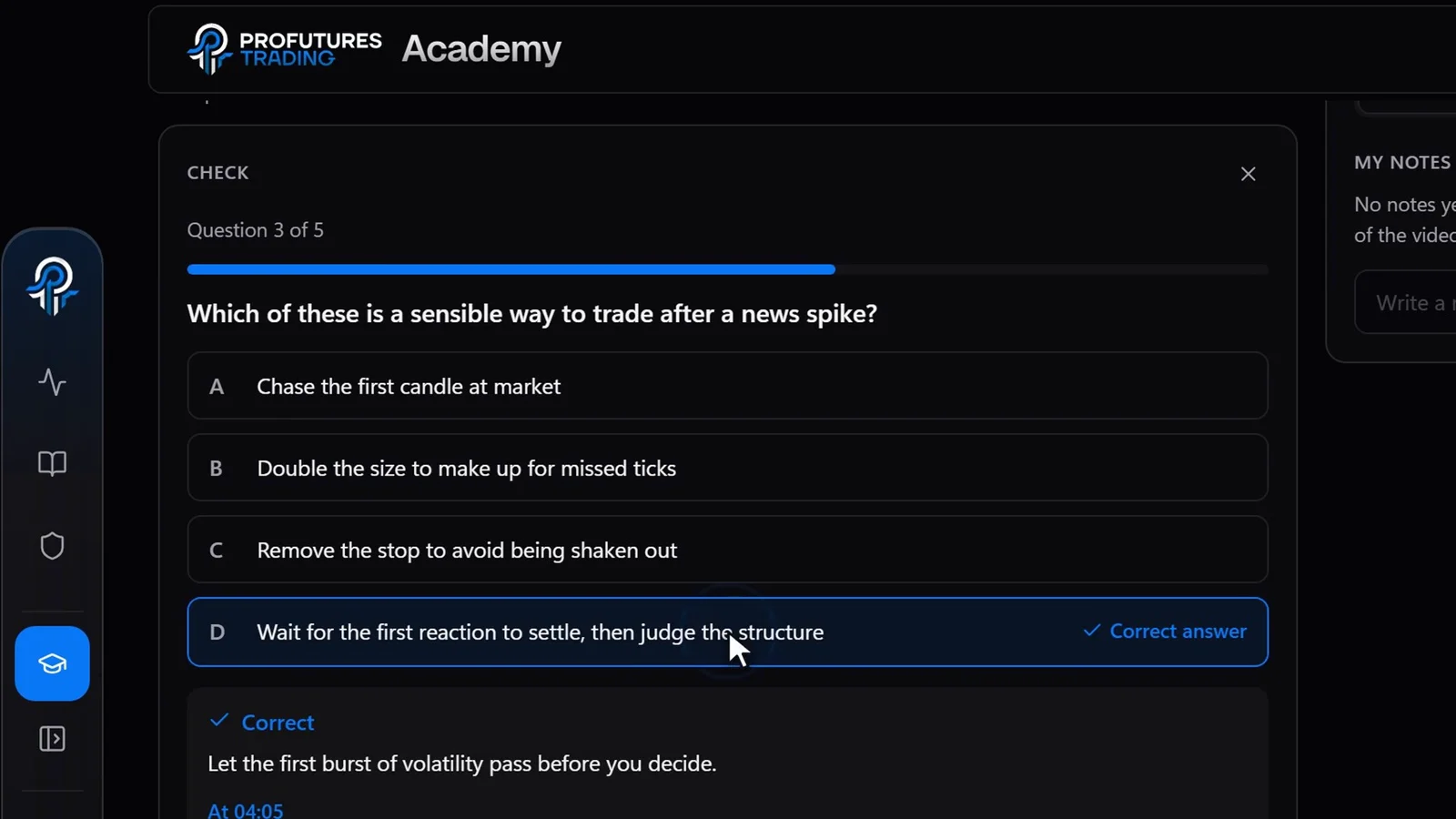
If you prefer a structured path to piecing it together alone, the PFT Academy is built around the learning order above. The Intraday course consists of 240+ videos that build on each other. After each lesson there is a short check, and the next lesson opens once you pass it. The course includes setting up ATAS, your data feed and an order flow workspace, writing your own trading plan, practising in demo and replay, and reviewing trades with journal data. The PFT indicators and the PFT Terminal are included for students.
The Academy gives no signals and promises no profits. It is designed to help you learn to read the market and to trade your own written plan, and your results depend on your own decisions, discipline and capital. A short first call lets you ask whether it fits you, with no pressure to buy.
FAQ
How do I start day trading as a beginner?
Learn the market first, then price and order flow, then risk, and practise in replay before you trade live. Start with one futures contract, a written plan and a daily loss limit, and journal every trade.
How long does it take to learn day trading?
There is no fixed number. Judge your progress by your journal: once you follow your written rules consistently over a meaningful number of trades, you are ready to trade very small size live.
Can I learn day trading for free?
You can learn the concepts from free material, and a free journal helps you review. What a course adds is order and feedback. The cost of learning without either is usually paid in losing trades.
How much money do I need to start?
That depends on the contract, your broker and your risk limits, so check the current requirements with your broker. A good rule is to start with an amount you can lose completely without it affecting your life, and to size each trade from a fixed risk limit.
Is day trading futures good for beginners?
It suits beginners who want to focus on one market with transparent data. It is still risky, and leverage can magnify losses. Micro contracts allow smaller position sizes while you learn.
Do I need to use order flow?
No. You can trade without it. PFT teaches order flow because it shows executed trades rather than only price, which many traders find a clearer basis for decisions. Whether it fits your style is something to test in replay.
Futures trading involves a substantial risk of loss. This article is educational and is not investment advice.