

Futures vs Options: Which Fits an ES and NQ Day Trader?
A futures contract is an obligation to buy or sell at a set price on a set date. An option is a right, not an obligation, that you pay for up front. For a day trader in ES or NQ, that one difference changes how losses are capped, what you pay, how time affects you and how simple the trade is. Futures are the more direct tool for intraday work. Options are useful to understand even if you never trade them, because their positioning moves the futures market.
This is an education article, not a recommendation. PFT is built around futures and order flow, so that is the side we know best, and we say where options are the better fit in some situations.
The one-line difference: obligation vs right
With a futures position, profit and loss follow the price one for one. If you are long one contract and price rises by one point, you gain one point times the contract multiplier. If it falls, you lose the same. Nothing is paid for the position itself. You post margin as a deposit, and the exchange and your broker set that amount.
With a bought option, you pay a premium. You can lose that premium and no more, and your gain depends on a move that is large enough to cover it. In options language, a futures position has a delta of 1 and nothing else. An option has a delta between 0 and 1 for a call (0 and -1 for a put) that changes as price moves.
Risk profile side by side
| Futures (long or short) | Option bought | Option sold | |
|---|---|---|---|
| Commitment | Obligation | Right | Obligation |
| Upfront cost | Margin deposit, not a cost | Premium, paid in full | Premium received, margin required |
| Maximum loss | Large, set by how far price moves and your stop | The premium paid | Large, can exceed the premium by far |
| Time decay | None | Works against you | Works for you |
| Payoff shape | Straight line | Bent: limited loss, open gain on a call | Bent: limited gain, large loss |
| Reacts to volatility | Only through price | Yes (vega) | Yes (vega) |
Futures vs options for a day trader. Margin amounts and fees are left out on purpose: they depend on the broker, the product and the day.
A bought option has a defined maximum loss, but that loss happens often: every option that expires out of the money loses its entire premium. A futures position has no premium to lose, but a gap or a fast move can take a loss beyond your plan if you do not use a stop and a size you can afford. Both are risky in different ways, and neither is safe.
Costs and capital
Futures need margin, a deposit that the broker and exchange set and can change. Micro contracts exist for smaller accounts. Options need the premium paid in full when you buy them, and margin when you sell them.
The multiplier also differs by product. Options on E-mini S&P 500 futures use $50 per index point (CME Group). SPX index options use a multiplier of 100, so one point is $100 (Cboe). An option premium looks small as a number, but it is multiplied, so check the dollar value before you place the order.
A hidden cost in options is the spread. Option contracts far from the money or far from expiry often have wide bid and ask quotes, and you pay that gap when you get in and out. A liquid futures contract usually has a tight spread, which matters most to someone who trades several times a day.
Speed and simplicity for day trading
For a short-term, chart-based trader, futures are simpler. One instrument, one price, one stop level, profit and loss that move with every tick. You can read the footprint, the volume profile and the delta on the same instrument you trade.
An option adds layers on top of that chart. Before you place a trade you have to choose a strike and an expiration. After that, your result depends on price, time and implied volatility together. A trade can be right on direction and still lose because the move was slow. For a day trader this is manageable on 0DTE contracts, which expire the same day, but those are fast, decay quickly and are not for beginners.
- Futures: direct, linear, a clear stop distance, tight spreads in the main contracts.
- Options: convex payoff, time decay, choice of strike and expiry, wider spreads away from the money.
Neither tool predicts price. If you trade futures with order flow, the same discipline applies in both cases: a defined plan, a risk limit per trade, and a review of what happened.
Where options still matter for a futures trader
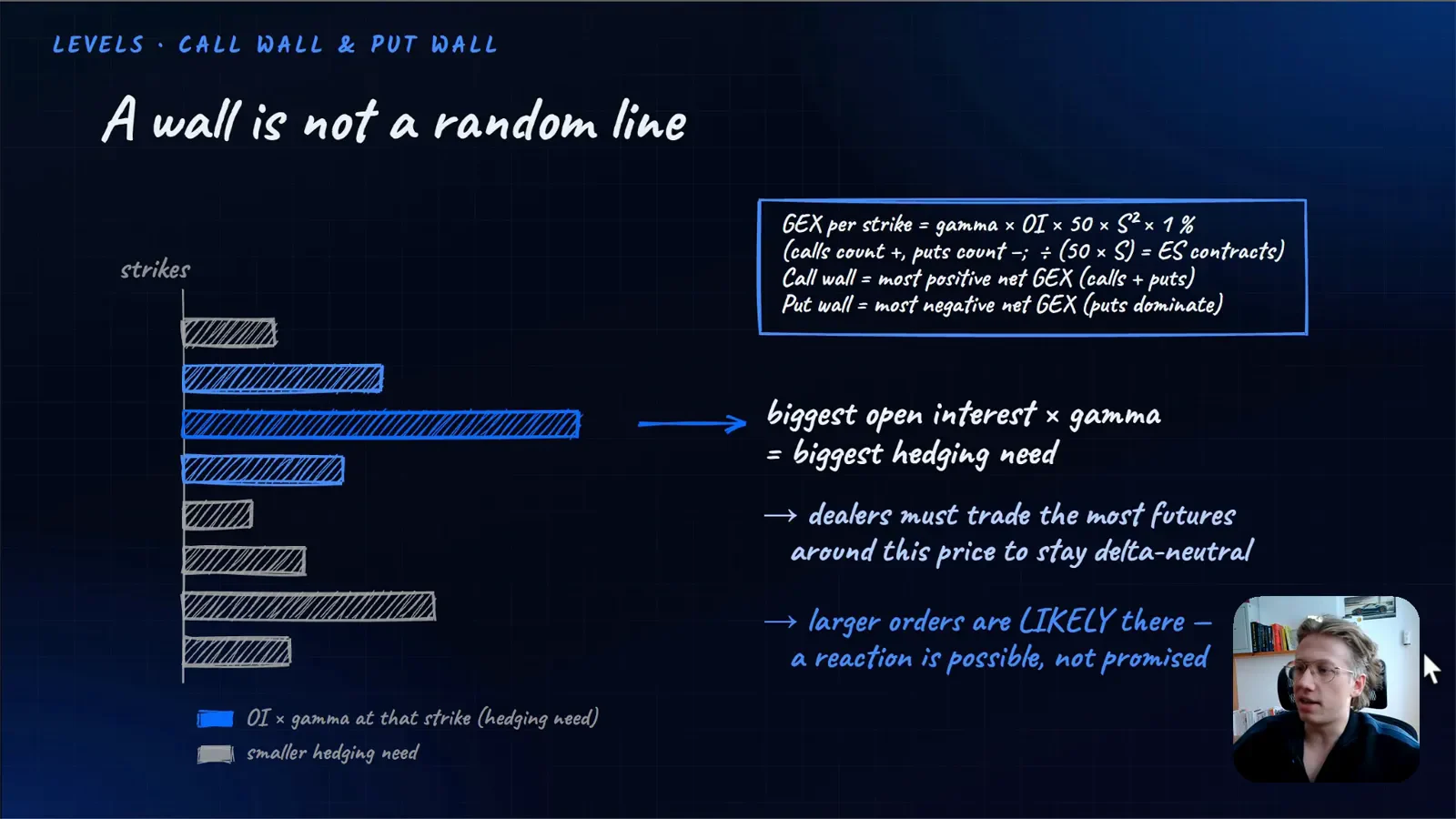
Even if you only trade futures, options shape your day. Dealers who sell options hedge in the futures market, and the size of that hedging depends on how many options are open at each strike and how close price is to them. Delta tells the dealer how much to hold. Gamma tells the dealer how fast that amount changes when price moves.
When dealers are net long gamma, their hedging tends to lean against moves: they sell into rallies and buy into dips, which can dampen price. When they are net short gamma, hedging tends to follow moves and can amplify them. That is the idea behind gamma exposure, GEX, and behind levels such as zero gamma, the call wall and the put wall.
Treat these levels as context. GEX is an estimate: it assumes who is long and who is short, it uses data that is not live to the second, and it says nothing about when price will reach a level or whether it will react there. Use it as a map and let the order flow on your chart show whether the level matters today.
PFT is building an options module called Forge. It is in development, with a waitlist on the options page and no release date or price announced.
Options on futures: what they are
An option on a futures contract is an option whose underlying is the futures contract itself. Options on E-mini S&P 500 futures are listed by CME Group. If such an option is exercised, the result is a futures position (CME Group). That is different from SPX index options, which are cash settled (Cboe): there, expiry produces a cash amount and no position.
This is why options on ES and the SPX index are not the same product even though both follow the S&P 500. The multiplier, the exercise rule and the settlement differ. Read the contract specification of the exact product, and the rules of your broker, before you trade it.
| SPX options (Cboe) | Options on E-mini S&P 500 futures (CME Group) | |
|---|---|---|
| Underlying | The S&P 500 index | An E-mini S&P 500 futures contract |
| Multiplier | 100 (notional is index level times $100) | $50 per index point |
| Result of exercise | Cash settlement, no delivery | A futures position |
SPX index options vs options on E-mini S&P 500 futures, for the points where both exchanges state the rule.
How to choose
The table matches the goal to the tool. It is a way of thinking, not advice about what you should do.
| Your situation | Tends to fit | Why |
|---|---|---|
| Trading short-term price moves from the chart | Futures | Direct, linear and the simplest to size and stop |
| Small account, want small size | Micro futures | Smaller contract size, same instrument |
| Want a fixed maximum loss per trade | Options bought, or futures with a hard stop | The premium caps the loss, a stop caps it too |
| Reading where dealers hedge | Options data as context | You do not need to trade options to use it |
| Selling options for income | Not covered here | Large and unlimited risk, needs a full separate education |
Matching the goal to the instrument.
If you are still learning, starting with the product you read on the chart keeps the number of moving parts low. Learning one futures contract and its order flow first, before adding anything else, is a common way to build up.
FAQ
What is the main difference between futures and options?
A futures contract is an obligation to buy or sell at a set price on a set date, and its profit and loss follow price directly. An option is a right you pay a premium for, with a payoff that bends and that is affected by time and volatility.
Which is riskier, futures or options?
Neither is safe. A bought option can lose its whole premium, often. A futures position or a sold option can lose far more than you planned if the market moves quickly and you have no stop or the stop does not fill at your price. The risk depends on size, structure and how you manage the trade.
Do futures traders need to understand options?
It helps. Options dealers hedge in the futures market, and their positioning is behind levels such as zero gamma, the call wall and the put wall. You can use these as context for an ES or NQ chart without ever trading an option.
What are options on futures?
Options whose underlying is a futures contract, for example options on E-mini S&P 500 futures listed by CME Group. Exercise produces a futures position, not a cash amount.
Is a micro futures contract an option?
No. A micro future is a smaller version of a regular futures contract. It keeps the futures payoff but lets you trade a smaller size.
Does PFT offer options trading?
No. PFT is built for futures and order flow. It is developing a module for reading options positioning, called Forge, which is in development and has a waitlist. Taxes and regulation for derivatives depend on your country and are not covered here.
Options involve risk and are not suitable for all investors. Futures trading involves a substantial risk of loss. This article is education, not investment advice.