

How Options Work: Calls vs Puts Explained for Futures Traders
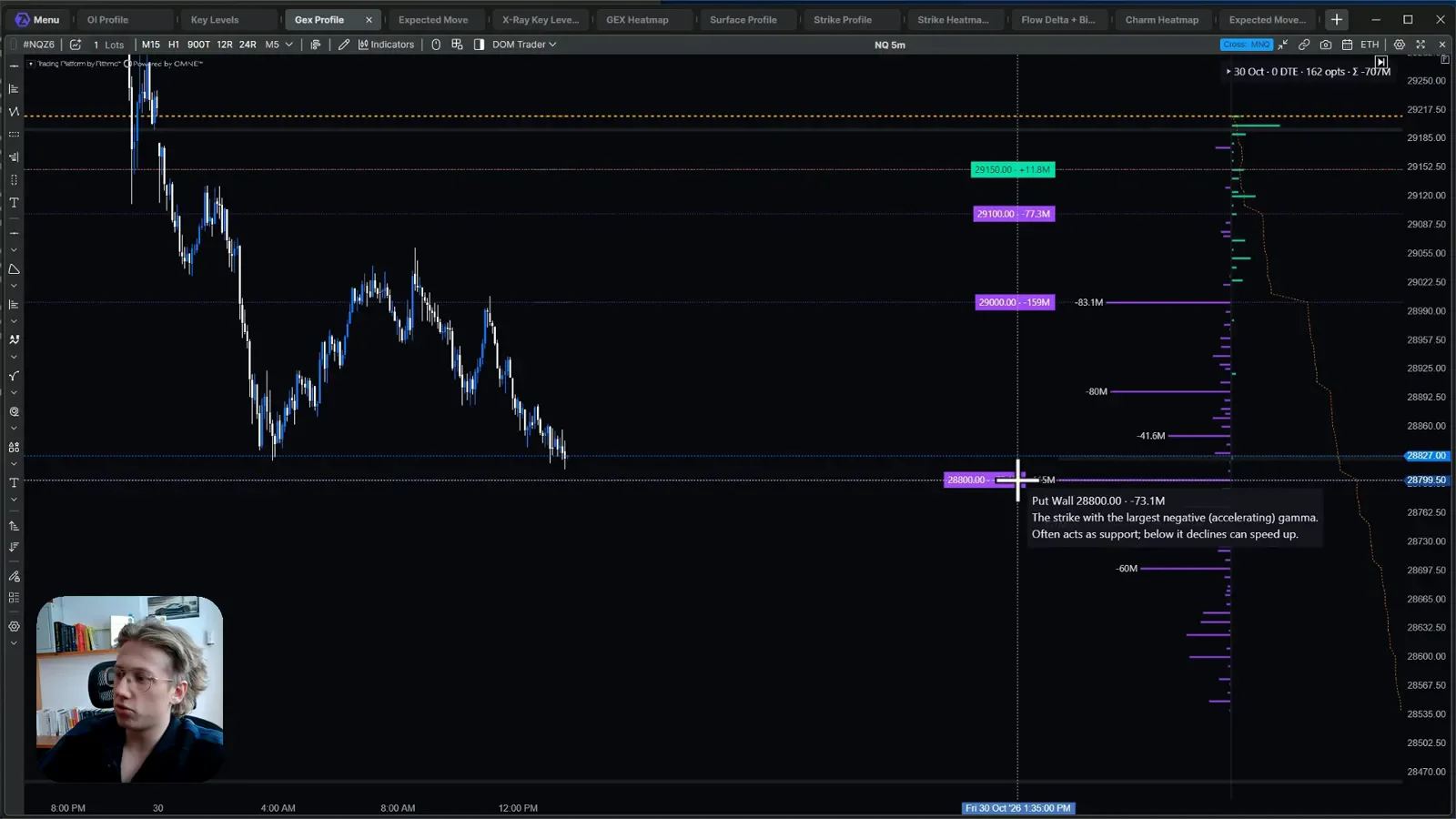
An option is a contract that gives its buyer the right, but not the obligation, to buy or sell an asset at a fixed price before or on a fixed date. A call is the right to buy, a put is the right to sell. The buyer pays a price for that right, called the premium, and the seller collects it and takes on the obligation. That is the whole idea. Everything else, from Greeks to gamma exposure, is detail built on top of it.
This guide is written for futures traders. We do not suggest you trade options. We explain them because options positioning moves the ES and NQ charts you trade, and you cannot read that effect without knowing what a call and a put actually are.
What is an option?
An option has four defining terms. Once you know them, any option quote becomes readable.
- Underlying. The asset the option refers to: a stock, an index such as the S&P 500, or a futures contract such as ES.
- Strike price. The fixed price at which the right can be used.
- Expiration. The date the right ends. After that, the option is worthless or settled.
- Premium. The price the buyer pays and the seller receives. It is quoted per unit and multiplied by a contract multiplier.
The multiplier turns the quote into dollars. SPX index options, for example, use a multiplier of 100, so a quoted premium of 40 index points is $4,000 per contract (Cboe, notional value is the index level times $100). Options on E-mini S&P 500 futures use a multiplier of $50 per index point (CME Group). Always check the multiplier of the exact product before you think in dollars.
What is the difference between a call and a put?
A call gains value when the underlying rises. A put gains value when it falls. Each one is a bet on a direction only for the buyer, and only up to the premium paid.
| Call option | Put option | |
|---|---|---|
| The right to | Buy the underlying at the strike | Sell the underlying at the strike |
| Buyer profits when | Price rises above strike plus premium | Price falls below strike minus premium |
| Buyer's maximum loss | The premium paid | The premium paid |
| Seller's obligation | Sell at the strike if exercised | Buy at the strike if exercised |
| Seller's maximum gain | The premium received | The premium received |
Calls and puts side by side. The buyer holds the right, the seller holds the obligation.
You will see both terms searched together as call vs put or calls and puts. They are two halves of one market: for every buyer there is a seller, and the two sides have very different risk.
A worked example with round numbers
The numbers below are an illustration, not market data. Assume an index future trades at 6,000 and each index point is worth $50.
You buy one call with a strike of 6,000 for a premium of 40 points. That costs 40 x $50 = $2,000, and it is the most you can lose. Your breakeven at expiration is 6,000 + 40 = 6,040.
| Price at expiration | Call buyer (strike 6,000, premium 40) | Put buyer (strike 6,000, premium 40) |
|---|---|---|
| 5,900 | -40 points (-$2,000) | +60 points (+$3,000) |
| 6,000 | -40 points (-$2,000) | -40 points (-$2,000) |
| 6,040 | 0 (breakeven) | -40 points (-$2,000) |
| 6,100 | +60 points (+$3,000) | -40 points (-$2,000) |
Payoff at expiration for the bought call and for a bought put with the same strike and premium (illustration, round numbers).
Read the table row by row. If price ends at 6,100, the call is worth 100 points at expiration (6,100 minus 6,000), and after the 40 points of premium you are 60 points ahead. If price ends anywhere below 6,000, the call expires worthless and you lose the premium, no matter how far price fell. That is the defining shape of a bought option: limited loss, open-ended gain on the call side.
Buyer vs seller: who carries which risk?
The seller of an option is the mirror image of the buyer. In the example above, the seller of that 6,000 call collected 40 points. If price ends at 6,100, the seller owes 100 points and ends 60 points down, $3,000 against the $2,000 collected. If price rallies further, the loss keeps growing.
- Buyer: pays the premium up front, loss is capped at that premium, needs a move large enough to cover it.
- Seller (writer): receives the premium, wins most of the time by small amounts, and can lose far more than the premium when the market moves hard.
Sellers who do not own the underlying are exposed to what is called uncapped or very large risk. That asymmetry is why most beginner material warns against selling options without understanding the risk first. Options involve risk and are not suitable for all investors.
Strike, moneyness and expiration
Where the strike sits relative to the current price is called moneyness. It tells you how much of the premium is real value today and how much is hope.
| Term | Call (example strike) | Put (example strike) |
|---|---|---|
| In the money | Strike below price (5,900) | Strike above price (6,100) |
| At the money | Strike near price (6,000) | Strike near price (6,000) |
| Out of the money | Strike above price (6,100) | Strike below price (5,900) |
Moneyness for calls and puts, with the underlying at 6,000 (illustration).
Expiration is the clock. The closer an option gets to expiry, the less time price has to make a move, and the faster the part of the premium that is pure time disappears. Index options now list many expirations, from monthly to daily. Cboe, for example, lists standard, weekly and daily expirations for SPX options.
Intrinsic value and time value
Every premium splits into two parts. Intrinsic value is what the option would be worth if exercised right now: for the 5,900 call with the underlying at 6,000, that is 100 points. Time value is everything above that. It is what the market pays for the chance that price moves further before expiry. An out-of-the-money option has no intrinsic value at all, so its whole premium is time value.
At expiration time value is zero. Whatever was paid for it is gone. That is the cost of holding an option, and it is the reason a bought option can lose money even when you guessed the direction right but price moved too slowly.
American vs European exercise
An American-style option can be exercised at any time up to expiry. A European-style option can be exercised only at expiry. The label has nothing to do with geography. It matters for risk: with a European-style option the seller cannot be assigned early. Cboe describes SPX options as exercisable only at expiration and as settling in cash, without delivery of shares.
Settlement matters too. With index options settled in cash, expiry produces a cash amount. With options on futures, exercise produces a position in the futures contract (CME Group). Check both rules for the product you look at.
The four Greeks in plain words
The Greeks measure how an option's price reacts to changes in the market. You do not need formulas to use the ideas.
| Greek | What it measures | In one sentence |
|---|---|---|
| Delta | Change in option price per 1-point move in the underlying | A call's delta runs from 0 to 1, a put's from 0 to -1. A delta near 0.50 means roughly a 50 percent weight on the underlying. |
| Gamma | Change in delta per 1-point move | How fast delta itself changes. Highest for options near the money and close to expiry. |
| Theta | Change in option price as one day passes | Time decay. It works against the buyer and for the seller, and speeds up near expiry. |
| Vega | Change in option price per change in implied volatility | Options get more expensive when the market expects larger moves. |
The four Greeks that matter most for reading the market.
Of the four, delta and gamma matter most for futures traders, and the next section shows why.
Why options affect the futures you trade
Most option sellers and market makers do not want a directional bet. When a customer buys a call from a dealer, the dealer is short that call. To stay neutral, the dealer buys some of the underlying, or the futures contract, in proportion to the option's delta. As price moves and delta changes, the dealer has to adjust the hedge. Gamma is what sets how large those adjustments are.
That hedging flow is real order flow in the instrument you trade. Where options positions are large, hedging can slow price down or speed it up. This is the basis of gamma exposure, or GEX, and of levels such as the call wall and the put wall. It is a context for your chart, not a signal. The estimate rests on assumptions about who is long and who is short, and those assumptions can be wrong.
Reading an options chain and open interest
An options chain is a table of all listed options on one underlying and one expiration, with calls on one side and puts on the other, sorted by strike. For each strike it shows the bid and ask premium, volume and open interest. Open interest is the number of contracts that are open and not yet closed or expired. Volume counts trades in a day, open interest counts what is still outstanding.
Open interest by strike is the raw input behind many of the levels futures traders watch. Strikes with unusually large open interest are where hedging pressure tends to concentrate near expiry.
What to learn next
- Greeks in practice. Delta, gamma, theta and vega on real quotes.
- Dealer hedging. Why short-gamma and long-gamma regimes make price behave differently.
- Key levels. Zero gamma, call wall, put wall, max pain, and how they show up on the chart.
- Order flow around those levels. Footprint, delta and volume profile show whether price reacts.
PFT is building an options module for this, called Forge. It is in development today and has a waitlist on the options page, with no release date and no price. If your focus is the chart itself, the PFT Academy and the ATAS indicators cover the futures and order flow side.
FAQ
What is the difference between a call and a put?
A call is the right to buy at the strike price, a put is the right to sell. Calls gain value when the underlying rises, puts when it falls. The buyer's loss is limited to the premium in both cases.
How do options work in simple terms?
You pay a premium for a right that lasts until expiration. If the market moves enough in your favor, the right is worth more than you paid. If it does not, the option expires and the premium is lost. The seller takes the opposite side: keeps the premium if little happens, and pays out if the market moves against the position.
What is the maximum loss when buying an option?
The premium paid. In the worked example above that is 40 points, or $2,000 at $50 per point. Sellers have no such cap.
Why do options expire worthless?
An option that is out of the money at expiration has no intrinsic value, and time value is zero by then. Nothing is left to exercise, so the contract ends and the buyer loses the premium.
What are the Greeks?
Measures of how an option's price reacts to the underlying price (delta), the speed of that reaction (gamma), the passing of time (theta) and expected volatility (vega).
Do I need to trade options to use options data on futures?
No. Many futures traders only read options positioning as context, for example where dealers may need to hedge. Whether any of that fits your own plan is your decision. Taxes and rules for options depend on your country and are not covered here.
Options involve risk and are not suitable for all investors. Futures trading involves a substantial risk of loss. This article is education, not investment advice.